
MBA in Travel and Tourism Management: Course Details, Eligibility and Career Scope
A holiday might begin with a simple idea: spending a few days by the beach, exploring a historic city or visiting a destination you've always wanted to see. But turning that idea into an enjoyable travel experience involves much more than booking a flight and reserving a hotel room.
Someone has to plan the itinerary, coordinate transportation, arrange accommodation, manage bookings, understand local requirements and make sure travellers receive the experience they were promised. Behind a successful tourism business is an entire network of professionals working together.
This is what makes travel and tourism an interesting field to explore from a management perspective.
India has an exceptionally diverse tourism landscape. From heritage destinations and pilgrimage circuits to wildlife experiences, luxury resorts, adventure travel and business events, the sector involves a wide range of businesses and services. Each requires people who understand customer expectations as well as the operational side of the industry.
For students who enjoy travel, communication, planning and working with people, an MBA in Travel and Tourism Management can offer a route into this sector.
However, the course is not simply about learning different destinations or planning holidays. It focuses on managing tourism businesses, understanding traveller behaviour, developing services, handling operations and creating experiences that meet customer expectations.
Let's explore what the programme involves, the subjects students may study and the career opportunities available after graduation.
Why Is Travel and Tourism an Interesting Management Career?
Travel is a personal experience, but the industry behind it is a serious business.
Think about a popular tourist destination during a busy holiday season. Hotels need to manage room availability, restaurants must plan their supplies, transport providers have to coordinate schedules, and travel companies need to handle bookings and customer enquiries.
A sudden change in weather, a delayed flight or an unexpected booking cancellation can affect several parts of the experience.
Managing these situations requires planning, communication and quick decision-making.
The tourism industry also brings together different business sectors. Hotels, airlines, travel agencies, tour operators, destination management companies, cruise operators, event organisers and online travel platforms all contribute to the visitor experience.
This variety gives students several directions to explore. Someone interested in hotel operations may follow a different career path from someone who prefers tour planning, destination marketing or airline management.
An MBA in Travel and Tourism Management introduces students to this wider business environment and helps them understand how different parts of the industry function.
What Is an MBA in Travel and Tourism Management?
An MBA in Travel and Tourism Management is a postgraduate programme that combines general management education with specialised knowledge of the tourism and hospitality industry.
Students study business subjects such as marketing, finance, human resources, operations and organisational behaviour. Alongside these, they explore tourism-related topics such as travel operations, destination management, hospitality services, tourism marketing and customer experience.
The objective is to prepare students for managerial and operational responsibilities within travel-related businesses.
For example, managing a travel agency involves more than creating holiday packages. The business needs to understand customer requirements, negotiate with service providers, manage pricing, coordinate bookings and maintain service quality.
Similarly, a hotel manager must understand guest expectations while overseeing employees, budgets, room operations and business performance.
The programme helps students connect these responsibilities with broader management principles.
Different institutions may offer the course under titles such as MBA in Tourism Management, MBA in Hospitality and Travel Tourism or MBA in Travel and Tourism Management. The subjects and programme structure can vary, so students should always examine the actual syllabus before applying.
What Subjects Are Covered in the Course?
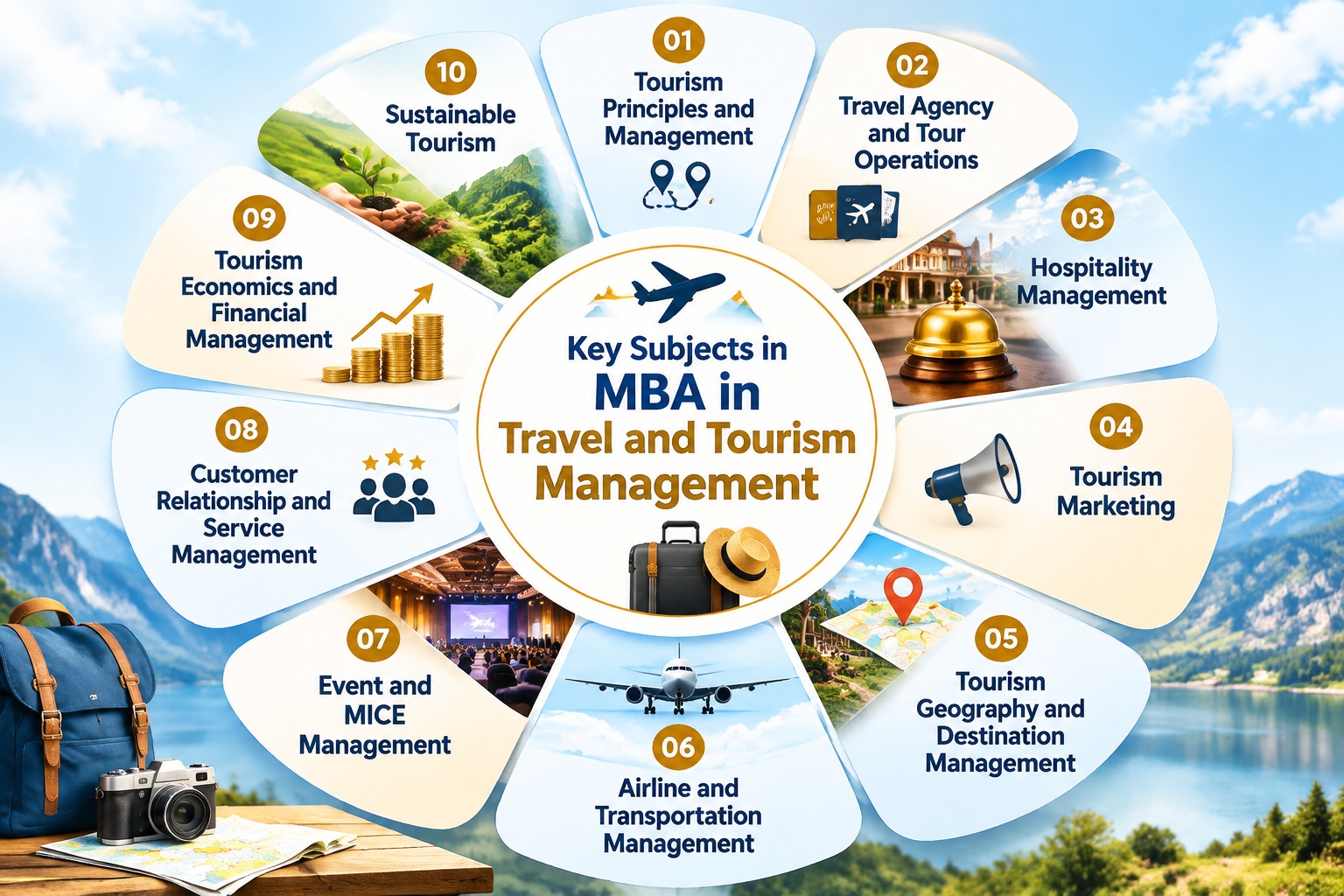
The curriculum usually combines core management subjects with specialised tourism and hospitality topics. The exact list depends on the institution, but the following areas are commonly relevant to this field.
1. Tourism Principles and Management
This subject introduces students to the tourism industry, its structure and the different activities that contribute to it.
Students explore different forms of tourism, including leisure travel, business tourism, cultural tourism, adventure travel and religious tourism.
They also learn how tourism businesses operate and how economic, social and cultural factors influence travel decisions.
2. Travel Agency and Tour Operations
Planning a tour involves coordinating several services, often across different locations.
This subject introduces students to itinerary preparation, travel arrangements, package development, reservations, supplier coordination and tour operations.
Students may also learn about the responsibilities of tour operators, travel consultants and destination management companies.
3. Hospitality Management
Travel and accommodation are closely connected. A tourist's experience is influenced not only by the destination but also by the quality of the hotel, resort or other accommodation they choose.
Hospitality management introduces students to hotel operations, guest services, front-office functions, housekeeping, food and beverage services and service quality.
It helps students understand how hospitality businesses manage daily operations while maintaining guest satisfaction.
4. Tourism Marketing
Tourism businesses need to communicate why travellers should choose one destination, property or travel experience over another.
Tourism marketing focuses on destination promotion, customer segmentation, branding, digital campaigns, travel trends and consumer behaviour.
Students may explore how travel companies use websites, social media, online reviews, content and advertising to attract potential customers.
5. Tourism Geography and Destination Management
A destination is more than a location on a map. Its attractions, accessibility, local culture, infrastructure, climate and available services all influence its tourism potential.
This subject introduces students to destination planning, tourism resources, geographical factors and the development of visitor experiences.
It can be particularly relevant for people interested in tourism boards, destination management companies and travel planning.
6. Airline and Transportation Management
Airlines, airports, railways, road transport and other mobility services play an important role in tourism.
Students may learn about transportation operations, passenger services, airline management, scheduling, customer handling and coordination between travel providers.
The subject provides an understanding of how transportation services support tourism businesses.
7. Event and MICE Management
MICE stands for Meetings, Incentives, Conferences and Exhibitions. It is an important segment of business tourism.
This area introduces students to event planning, venue coordination, guest management, travel arrangements, budgeting and event operations.
Students interested in corporate travel, conferences, exhibitions and large-scale events may find this subject particularly useful.
8. Customer Relationship and Service Management
Tourism is a service-driven industry. A traveller may remember a destination for years, but the quality of communication and service often influences how they evaluate the entire experience.
Students explore customer expectations, complaint handling, service quality, relationship management and customer retention.
These concepts are relevant across hotels, travel agencies, airlines, resorts and tourism service providers.
9. Tourism Economics and Financial Management
Tourism businesses must balance customer expectations with commercial requirements.
This subject introduces students to budgeting, pricing, revenue planning, cost management and the economic impact of tourism.
Understanding these concepts helps future managers evaluate business performance and make informed decisions.
10. Sustainable Tourism
Tourism can create employment and support local economies, but it also needs responsible planning.
Sustainable tourism introduces students to environmental protection, local community participation, cultural preservation and responsible visitor management.
The subject encourages students to think about how tourism businesses can grow while respecting the destinations and communities that make travel experiences possible.
What Skills Can You Develop During an MBA in Travel and Tourism Management?
A successful career in tourism requires a combination of people skills, business understanding and the ability to manage situations that do not always go according to plan.
Imagine a group arriving at a hotel earlier than expected, a tour itinerary changing because of weather or a customer needing urgent assistance with a booking. These situations require someone who can communicate clearly, understand the available options and coordinate a solution.
An MBA programme can help students develop the following skills.
Communication and interpersonal skills: Tourism professionals interact with customers, colleagues, vendors and business partners. Clear communication helps avoid misunderstandings and creates a better service experience.
Customer relationship management: Understanding what travellers expect and responding to their concerns is central to the industry. Students learn how customer satisfaction influences business reputation and repeat bookings.
Planning and coordination: Tour schedules, hotel reservations, transport arrangements and events involve multiple moving parts. Organisational skills help professionals manage these activities effectively.
Problem-solving: Travel plans can change unexpectedly. Professionals need to assess situations calmly and find practical alternatives without compromising service quality.
Leadership and team management: Hotels, travel companies and tourism organisations depend on people working across different departments. Managers must coordinate teams, delegate responsibilities and maintain service standards.
Commercial awareness: A tourism business must deliver enjoyable experiences while remaining financially sustainable. Understanding pricing, budgets, revenue and business performance is therefore important.
Cultural awareness: Travellers and tourism professionals come from different backgrounds. Understanding cultural differences helps create more inclusive and thoughtful customer experiences.
These capabilities are developed over time through academic learning, practical assignments, internships and professional interactions.
What Career Opportunities Are Available After an MBA in Travel and Tourism Management?
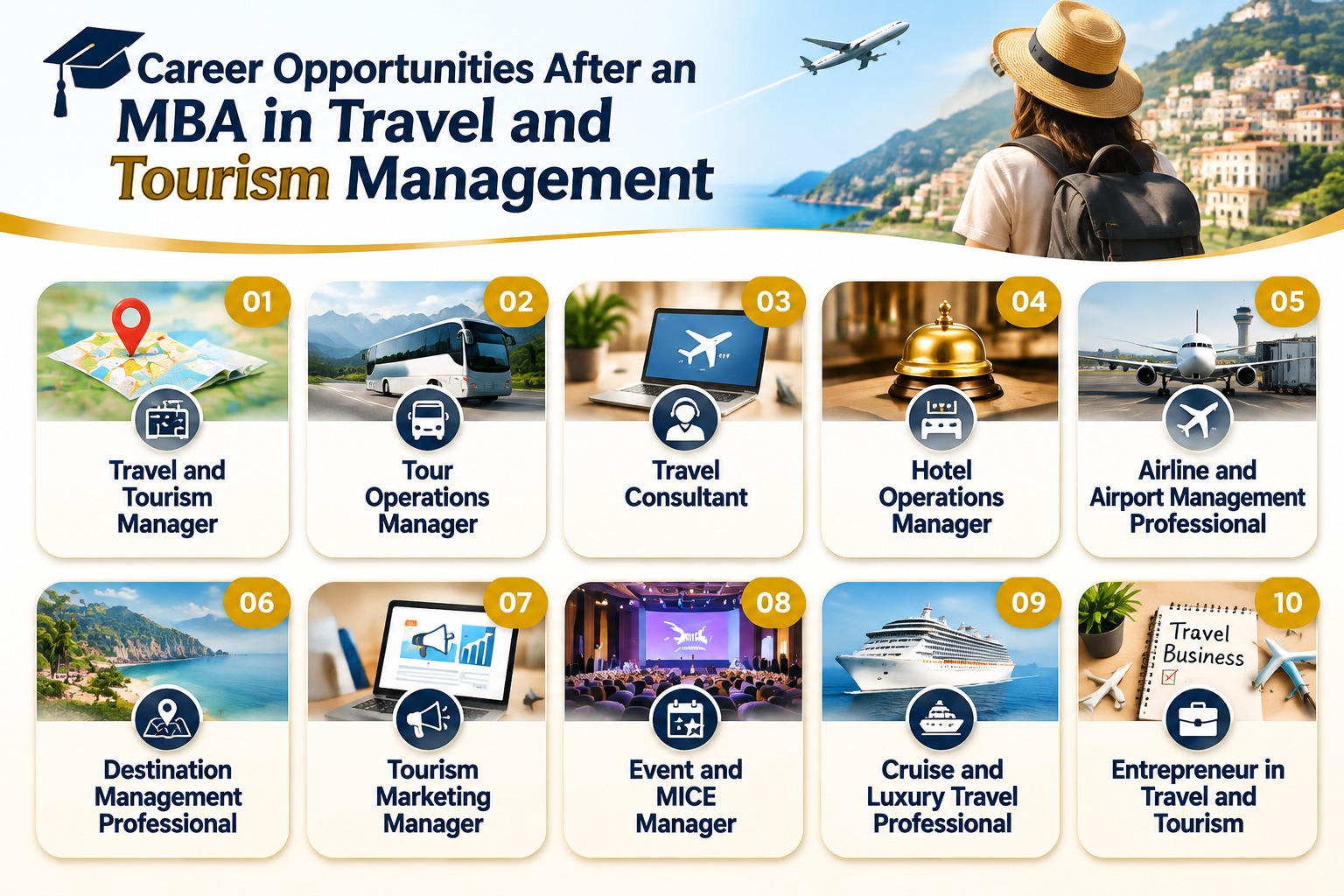
The career possibilities are wider than many students initially expect. Graduates can explore opportunities in hotels, airlines, travel companies, tourism organisations, event businesses and online travel platforms.
The role you pursue will depend on your interests, practical exposure and the skills you develop during your education.
1. Travel and Tourism Manager
Travel and Tourism Managers oversee business activities related to travel services and tourism operations.
Their responsibilities may include planning travel products, managing service providers, coordinating teams, monitoring customer satisfaction and developing business opportunities.
They may work with travel agencies, tour operators, destination management companies or tourism organisations.
2. Tour Operations Manager
Tour Operations Managers coordinate the practical aspects of organised travel experiences.
They may manage itineraries, transport arrangements, accommodation, guides, vendors and other services required for a tour.
The role involves attention to detail because even a small scheduling issue can affect an entire group of travellers.
3. Travel Consultant
Travel Consultants help customers select destinations, plan holidays and make travel arrangements.
They understand customer requirements, suggest suitable options, coordinate reservations and provide information about travel services.
With experience, professionals may move into specialised travel planning, luxury travel consulting or corporate travel management.
4. Hotel Operations Manager
Hotel Operations Managers oversee the activities that keep a property running smoothly.
Depending on the size and structure of the hotel, their responsibilities may include front-office operations, housekeeping coordination, food and beverage services, guest relations and operational planning.
The role requires strong organisational skills and an understanding of hospitality standards.
5. Airline and Airport Management Professional
Airlines and airports offer several career paths related to passenger services, ground operations, customer experience, sales and operational coordination.
Graduates may explore management-oriented opportunities depending on the employer's recruitment requirements and any additional qualifications needed for specialised roles.
6. Destination Management Professional
Destination management involves developing and promoting a location as a tourism destination.
Professionals may work with tourism boards, destination management companies, local businesses and hospitality providers.
Their responsibilities can include tourism planning, visitor experience development, promotional activities and coordination with local stakeholders.
7. Tourism Marketing Manager
Tourism Marketing Managers develop strategies to attract travellers to destinations, hotels, resorts, travel companies or tourism products.
Their work may involve digital campaigns, brand positioning, social media, partnerships, content marketing and promotional planning.
This role can suit students who enjoy combining creativity with business strategy.
8. Event and MICE Manager
Corporate events, conferences, exhibitions and incentive travel require detailed planning.
Event and MICE Managers coordinate venues, accommodation, transport, suppliers, schedules, budgets and guest requirements.
The role can involve working with hotels, event agencies, convention centres and corporate organisations.
9. Cruise and Luxury Travel Professional
Cruise companies and luxury travel businesses focus on specialised customer experiences.
Opportunities may be available in guest services, reservations, travel planning, sales, operations and customer relationship management.
These roles often require strong communication skills and an understanding of premium service expectations.
10. Entrepreneur in Travel and Tourism
Some graduates may eventually choose to start their own travel-related businesses.
Possibilities include a travel consultancy, tour operating company, destination experience business, adventure tourism venture or specialised holiday planning service.
An understanding of marketing, operations, customer management and financial planning can help entrepreneurs build a more structured business.
Which Industries Recruit Travel and Tourism Management Graduates?
One advantage of studying this specialisation is that the knowledge can be applied across different sectors connected to travel and visitor services.
Hotels and Resorts
Hotels, resorts and serviced accommodation businesses need professionals for guest services, hotel operations, sales, revenue management and customer relations.
Airlines and Airports
Airlines and airports offer opportunities in passenger services, ground operations, airport hospitality, sales and customer experience.
Travel Agencies and Tour Operators
These businesses recruit professionals for itinerary planning, reservations, travel consulting, tour coordination and business development.
Event and Convention Businesses
Conferences, exhibitions and corporate travel create opportunities in event operations, venue management and MICE services.
Online Travel Companies
Online travel agencies and travel technology businesses need professionals in customer experience, digital marketing, sales, operations and business partnerships.
Tourism Boards and Destination Organisations
These organisations work on destination promotion, tourism development, visitor services and partnerships with local businesses.
Tourism knowledge can also be useful in adventure travel, cruise services, wellness tourism, medical tourism and heritage tourism. Each segment has its own customer expectations and operational requirements.
Who Should Consider This MBA Specialisation?
An MBA in Travel and Tourism Management may appeal to students who enjoy interacting with people, organising activities and understanding how service businesses work.
It can be particularly interesting for someone who likes travel but also wants to explore the commercial side of the industry.
You may want to consider this specialisation if you:
- Enjoy planning trips, events or customer experiences.
- Are interested in hotels, airlines and travel businesses.
- Like communicating and working with people.
- Want to understand how tourism companies operate.
- Are interested in marketing destinations and travel services.
- Would like to explore opportunities in hospitality or international tourism.
Students do not need to have travelled extensively before joining the programme. What matters more is their interest in the sector and willingness to learn about its business operations.
A student who enjoys organising college events, coordinating group activities or communicating with people may already have some useful transferable skills.
Eligibility and Admission Requirements
Eligibility varies across colleges and universities. However, an MBA in Travel and Tourism Management generally requires applicants to hold a bachelor's degree from a recognised university.
Many institutions accept graduates from different academic backgrounds. Students who have studied commerce, arts, science, business administration or other disciplines may be eligible, subject to the specific admission requirements.
Depending on the institution, the selection process may include an entrance examination, personal interview, group discussion or an internal assessment.
Before applying, check:
- Whether graduates from all disciplines are eligible.
- The minimum percentage or CGPA required.
- Whether students awaiting final-year results can apply.
- Whether an entrance examination is compulsory.
- The duration and format of the programme.
- The university awarding the MBA degree.
- Whether internships or industry placements are included.
For students comparing MBA tourism colleges in India, it is also worth checking whether the programme focuses more on travel operations, hospitality management, tourism marketing or a combination of these areas.
The title of the programme alone does not tell you everything about what you will study.
How Is an MBA in Travel and Tourism Different from a General MBA?
A general MBA introduces students to the major functions of business, including marketing, finance, human resources, operations and strategy. It provides a broad management foundation that can be applied across industries.
An MBA in Travel and Tourism Management builds on that foundation but focuses on the specific requirements of the tourism and hospitality sector.
For instance, a general MBA may teach students how to manage customer relationships. A tourism-focused programme explores how those relationships work in travel agencies, hotels, airlines and destination businesses, where customer experience is closely linked to service delivery.
Similarly, general operations management covers business processes, while tourism management may examine hotel operations, tour coordination, travel reservations and destination services.
Neither option is automatically better. Students should consider whether they want a broad management qualification or a programme that gives greater attention to the travel and hospitality industry.
How Technology Is Reshaping the Travel and Tourism Industry
Booking a holiday today looks very different from the way it did a decade ago. Travellers can compare hotel prices, read customer reviews, explore destinations through videos and make reservations using their phones.
Technology has changed how tourism businesses attract customers and manage their operations.
Some important developments include:
Online Travel Platforms: Digital booking platforms allow travellers to compare flights, accommodation, packages and experiences. Tourism professionals need to understand how these platforms influence customer decisions.
Artificial Intelligence: AI-powered tools are being used for customer support, personalised recommendations, travel planning and business analysis. They can help companies respond to customer requirements more efficiently.
Customer Relationship Management Systems: Tourism businesses use CRM platforms to manage enquiries, bookings, customer preferences and communication. These systems can help companies provide more organised and personalised services.
Digital Marketing: Social media, search engines, online reviews and travel content influence how people discover destinations. Businesses need professionals who understand how to communicate effectively through these channels.
Revenue Management Technology: Hotels and airlines use pricing and demand information to make decisions about availability, rates and revenue. Understanding the commercial side of these systems can be valuable for future managers.
Technology does not replace the human side of tourism. Travellers still value helpful service, local knowledge and thoughtful experiences. The opportunity lies in combining digital convenience with effective customer interaction.
Why Practical Exposure Is Important in Tourism Education
Tourism is an industry where the difference between knowing something and doing it can be significant.
A student may understand the principles of hotel management in a classroom, but working in a hotel environment introduces a different set of responsibilities. Guest enquiries, reservations, housekeeping coordination, food services and operational schedules all have to come together.
The same applies to travel operations. Planning an itinerary on paper is one thing. Coordinating with transport providers, hotels, local guides and customers is another.
This is why practical exposure deserves serious attention when choosing an MBA programme.
Internships, hotel visits, travel industry projects, workshops, guest lectures and workplace assignments help students understand how the sector operates. They also offer opportunities to develop communication, coordination and problem-solving skills.
The learning becomes more meaningful when students can connect management concepts with situations they may encounter in their professional lives.
How GEMS B School Connects Classroom Learning with the Travel Industry
For students looking at MBA tourism colleges in India, the programme structure is an important factor to consider.
GEMS B School offers an MBA + PGP in Hospitality and Travel Tourism through its Industry Synergised learning model. The programme combines an MBA degree with a PGP certification in Hospitality and Travel Tourism.
The work-study structure involves weekday industry engagement and weekend classroom learning. According to the institution's programme information, students work from Monday to Friday and attend classes on Saturdays and Sundays, with the learning model designed around approximately 70% practical exposure and 30% classroom learning.
The programme focuses on areas such as hotel operations, front-office management, customer service and travel operations. It is designed to help students connect academic concepts with professional experience in the hospitality and travel sectors.
The institution also lists industry placements with established hotel chains and travel companies as part of the programme offering. Students should speak with the admissions team to understand current employer arrangements, available roles and placement conditions before enrolling.
According to the programme information, applicants with a graduation degree in any discipline can apply, subject to the admission requirements. Students awaiting final-year results may also be eligible, and the selection process includes an online admission test.
This learning model may appeal to students who want to experience the professional environment while pursuing management education.
You can explore the GEMS B School MBA in Hospitality and Travel Tourism to learn more about the programme, structure and admission details.
What Does the Future Hold for Travel and Tourism Professionals?
The travel industry is constantly influenced by changing lifestyles, customer preferences, technology and economic conditions.
Travellers today may look for experiences that go beyond conventional sightseeing. Some prefer adventure activities, while others choose wellness retreats, heritage experiences, wildlife holidays or customised luxury travel.
Business travel, conferences, exhibitions and corporate events also contribute to demand for specialised tourism and hospitality services.
At the same time, businesses need to pay greater attention to service quality, digital communication, sustainable practices and personalised customer experiences.
These changes create opportunities for professionals who understand both the operational and commercial aspects of tourism.
However, the industry also requires flexibility. Seasonal demand, changing travel patterns and unexpected disruptions can affect businesses. Professionals who can plan carefully, communicate effectively and respond to new situations are better equipped to handle these challenges.
An MBA provides a foundation in management, but long-term growth also depends on practical experience, professional development and an understanding of how the industry evolves.
Conclusion
An MBA in Travel and Tourism Management offers an opportunity to explore a sector built around people, experiences and business operations. It combines management education with specialised knowledge of travel, hospitality, tourism marketing, customer service and destination management.
The career possibilities extend beyond travel agencies. Graduates can explore opportunities in hotels, airlines, tour operations, online travel platforms, event management, destination organisations and other tourism-related businesses.
Before selecting a college, examine its curriculum, practical learning opportunities, industry connections, faculty and placement support. Understand whether the programme provides exposure to the areas that interest you most.
Travel may be what attracts you to this industry, but building a successful career requires much more: an understanding of business, the ability to work with people and the confidence to manage changing situations.
A well-chosen MBA programme can help you develop that foundation and prepare for the many possibilities within the travel and tourism sector.
Frequently Asked Questions
1. What is an MBA in Travel and Tourism Management?
An MBA in Travel and Tourism Management is a postgraduate programme that combines business management education with specialised knowledge of travel, tourism and hospitality. It covers areas such as travel operations, destination management, tourism marketing, hotel management and customer service.
2. What are the subjects covered in an MBA in Travel and Tourism Management?
Common subjects include Tourism Management, Travel Agency and Tour Operations, Hospitality Management, Tourism Marketing, Destination Management, Airline Management, Event Management, Customer Relationship Management and Sustainable Tourism. The syllabus varies across institutions.
3. Who is eligible for an MBA in Travel and Tourism Management?
Graduates from recognised universities can generally apply, subject to the institution's admission criteria. Many colleges accept students from different academic backgrounds, including commerce, arts, science and business administration.
4. What jobs can I get after an MBA in Travel and Tourism Management?
Graduates can explore careers as Travel Consultants, Tour Operations Managers, Hotel Operations Managers, Tourism Marketing Managers, Event Managers, Destination Management Professionals and professionals in airline and airport operations.
5. Is an MBA in Travel and Tourism Management a good career option?
It can be a suitable choice for students interested in travel, hospitality, customer experience and service management. The programme provides exposure to an industry with opportunities across hotels, airlines, travel companies, events and destination services.
6. Can I pursue an MBA in Travel and Tourism without a hospitality background?
Yes. Many institutions accept graduates from different academic disciplines, provided they meet the eligibility requirements. Previous experience in hospitality or tourism is not necessarily compulsory.
7. What is the difference between Tourism Management and Hospitality Management?
Tourism Management focuses on travel services, destinations, tour operations and visitor experiences. Hospitality Management concentrates more on accommodation, food and beverage services, guest relations and hotel operations. Both areas overlap within the wider travel and tourism industry.
8. Why is practical experience important during an MBA in Travel and Tourism Management?
Practical experience helps students understand how hotels, travel agencies, airlines and tourism businesses operate. Internships, industry projects and workplace exposure can strengthen communication, customer handling, coordination and problem-solving skills.