MBA in Supply Chain Management: Course Details, Scope and Career Opportunities
Think about the last time you ordered something online. You selected a product, made the payment and received a delivery estimate. A few days later, the package arrived at your doorstep. The entire experience may have felt straightforward, but a lot had to happen behind the scenes.
The product had to be available in a warehouse, the inventory needed to be updated, the order had to be processed, transportation had to be arranged and the delivery had to reach the correct address. If even one part of this process failed, the customer experience could have been very different.
This is the world of supply chain management.
From the food we buy and medicines we depend on to automobiles, clothing and electronic devices, almost every product passes through a network of suppliers, manufacturers, warehouses, distributors and retailers before reaching its final destination.
Managing this network requires planning, coordination, technology and sound business decisions. As a result, supply chain management has become an important area of business education.
An MBA in Supply Chain Management helps students understand how goods, information and resources move through businesses. It combines management principles with specialised knowledge of logistics, procurement, inventory, operations and distribution.
For students interested in business operations and problem-solving, this specialisation offers an opportunity to explore a field that connects several industries.
Why Has Supply Chain Management Become So Important?
A business can manufacture an excellent product, but that alone does not guarantee success. The product must reach customers at the right time, in the right quantity and at a cost the business can manage.
Consider a supermarket. It needs to ensure that everyday essentials are available on its shelves. If too much stock is ordered, products may remain unsold or expire. If too little is ordered, customers may find empty shelves and choose another store.
A similar challenge exists in manufacturing. A factory depends on raw materials, machinery, suppliers and transportation. Delays in receiving even one essential component can interrupt production.
Supply chain professionals work to prevent these situations by coordinating different activities and identifying potential problems before they affect the business.
The importance of this function has become more visible with the growth of e-commerce, international trade, organised retail and technology-driven manufacturing. Customers expect faster deliveries, businesses want better inventory control, and organisations are increasingly interested in building efficient and resilient supply networks.
This has created a need for professionals who understand both the operational and managerial aspects of the supply chain.
What Is an MBA in Supply Chain Management?
An MBA in Supply Chain Management is a postgraduate management programme focused on planning and managing the movement of products, materials, services and information across a business network.
The programme generally covers core management subjects alongside specialised areas such as logistics, procurement, inventory management, operations, distribution and supply chain strategy.
Students learn how businesses select suppliers, manage purchasing activities, forecast demand, organise warehouses, coordinate transportation and monitor operational performance.
The course also introduces the role of technology in modern supply chains. Businesses increasingly use data analytics, automation, enterprise resource planning systems and digital tracking tools to improve visibility and make better operational decisions.
The objective is not simply to teach students how goods move from one location to another. It is to help them understand how the entire process contributes to business performance.
What Will You Study During an MBA in Supply Chain Management?
The curriculum varies across institutions, but a well-rounded programme usually includes management fundamentals and specialised supply chain subjects.
Here are some of the important areas students may encounter.
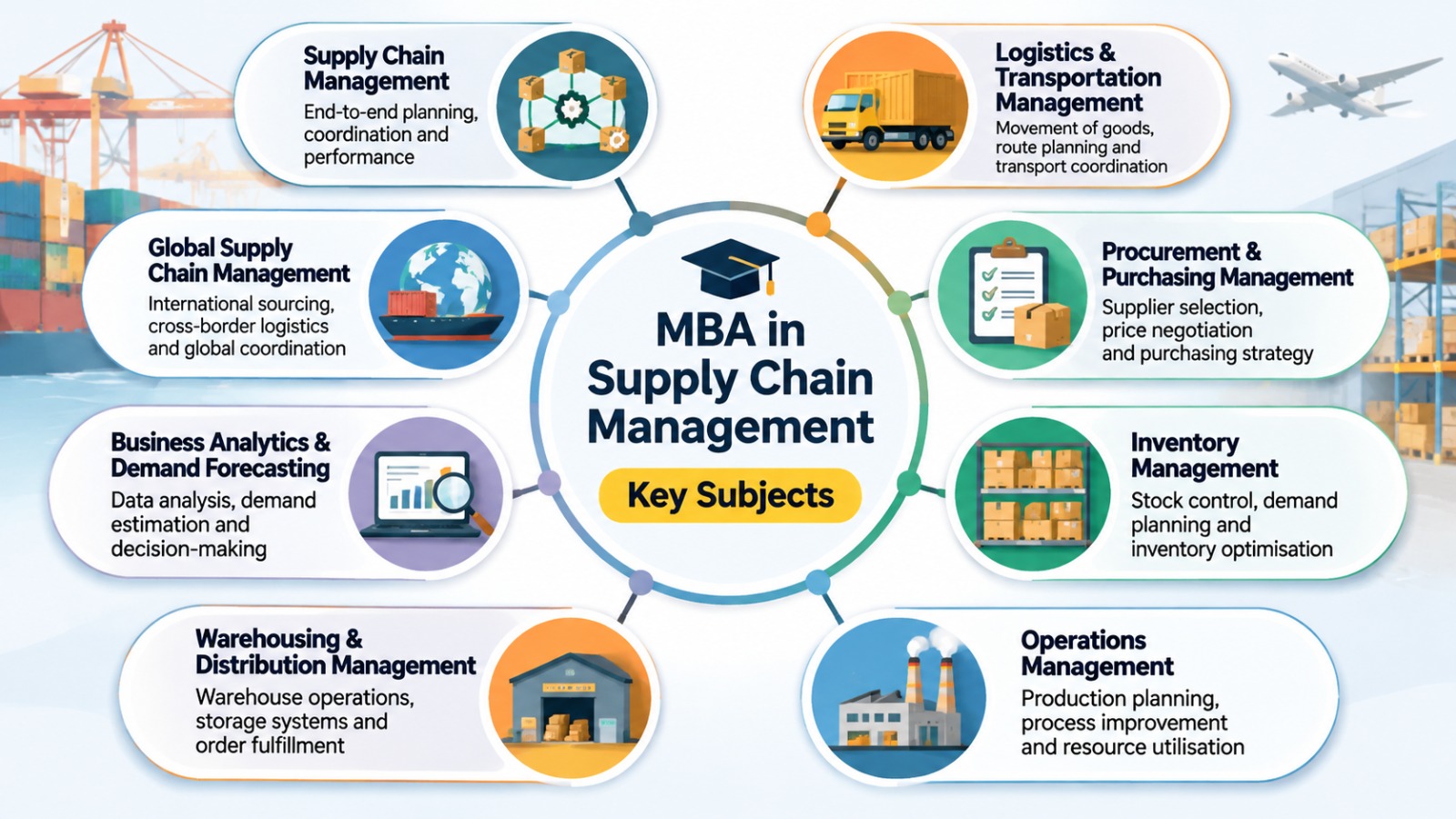
1. Supply Chain Management
This is the foundation of the specialisation. Students explore how different stages of a supply chain connect, from sourcing raw materials to delivering finished products.
Topics may include supply chain planning, coordination, performance measurement, network design and supplier relationships.
The subject helps students understand why individual departments cannot operate in isolation. Purchasing, production, warehousing and distribution must work together for the business to function efficiently.
2. Logistics and Transportation Management
Logistics focuses on the storage and movement of goods. Transportation management deals with selecting suitable transport methods, planning routes, coordinating deliveries and managing associated costs.
Students may learn about road, rail, air and sea transportation, freight management, distribution networks and delivery planning.
For businesses operating across multiple cities or countries, effective logistics can make a considerable difference to cost, delivery timelines and customer satisfaction.
3. Procurement and Purchasing Management
Before a product can be manufactured or a service delivered, businesses need the right materials and resources.
Procurement involves identifying suppliers, evaluating quotations, negotiating terms, placing orders and managing supplier relationships.
Students learn how organisations make purchasing decisions while balancing quality, cost, reliability and delivery requirements.
4. Inventory Management
Inventory refers to the materials, components and finished products that businesses keep available for their operations.
Too much inventory can increase storage costs and tie up working capital. Too little can lead to production delays, missed sales and unhappy customers.
This subject introduces students to stock control, inventory planning, demand forecasting, reorder levels and inventory optimisation.
5. Operations Management
Operations management examines how organisations convert resources into products or services.
Students explore production planning, process improvement, quality management, resource utilisation and operational efficiency.
It is closely connected to supply chain management because purchasing, production and distribution decisions influence one another.
6. Warehousing and Distribution Management
Warehouses are important links between manufacturers, suppliers and customers.
This subject introduces students to warehouse operations, storage systems, order processing, stock movement and distribution planning.
Students also learn why warehouse layout, accurate inventory records and efficient order fulfilment matter to businesses.
7. Business Analytics and Demand Forecasting
Supply chain decisions depend heavily on information.
Businesses need to estimate future demand, monitor inventory, evaluate supplier performance and identify patterns in their operations.
Business analytics introduces students to the use of data in decision-making. Depending on the curriculum, students may work with forecasting methods, spreadsheets, reporting tools and data visualisation platforms.
8. Global Supply Chain Management
Many businesses depend on suppliers, manufacturers and customers located in different countries.
Global supply chain management examines international sourcing, cross-border transportation, trade-related considerations, supplier coordination and the challenges of managing operations across markets.
It gives students a broader understanding of how international business activities influence supply chain decisions.
Skills That Matter in Supply Chain Management
Supply chain management is a practical field. Professionals deal with schedules, people, suppliers, budgets, transportation and unexpected disruptions. Knowing the theory is useful, but the ability to make sensible decisions when plans change is just as important.
An MBA programme can help students develop several capabilities that are valuable in this profession.
Analytical thinking: Supply chain decisions often involve comparing costs, delivery times, inventory levels and supplier performance. Students need to understand information and use it to support decisions.
Planning and organisation: Managing several activities at once requires careful planning. Professionals must coordinate timelines, resources and people while keeping business priorities in mind.
Negotiation: Procurement and supplier management involve discussions about prices, quality, delivery schedules and contract terms. The ability to negotiate professionally can make a difference.
Problem-solving: A delayed shipment, shortage of raw materials or sudden increase in demand can disrupt operations. Supply chain professionals need to assess the situation and find workable solutions.
Communication: The job involves working with suppliers, warehouse teams, transport partners, production departments and management. Clear communication helps avoid confusion and keeps activities moving.
Technology awareness: Modern supply chains use digital platforms to manage inventory, track shipments, forecast demand and coordinate operations. Familiarity with business software and data tools is increasingly useful.
Adaptability: Supply chain plans do not always go as expected. Professionals must be prepared to respond to changing customer requirements, supplier issues and market conditions.
These skills develop through a combination of academic learning, practical assignments, internships and professional experience.
Career Opportunities After an MBA in Supply Chain Management
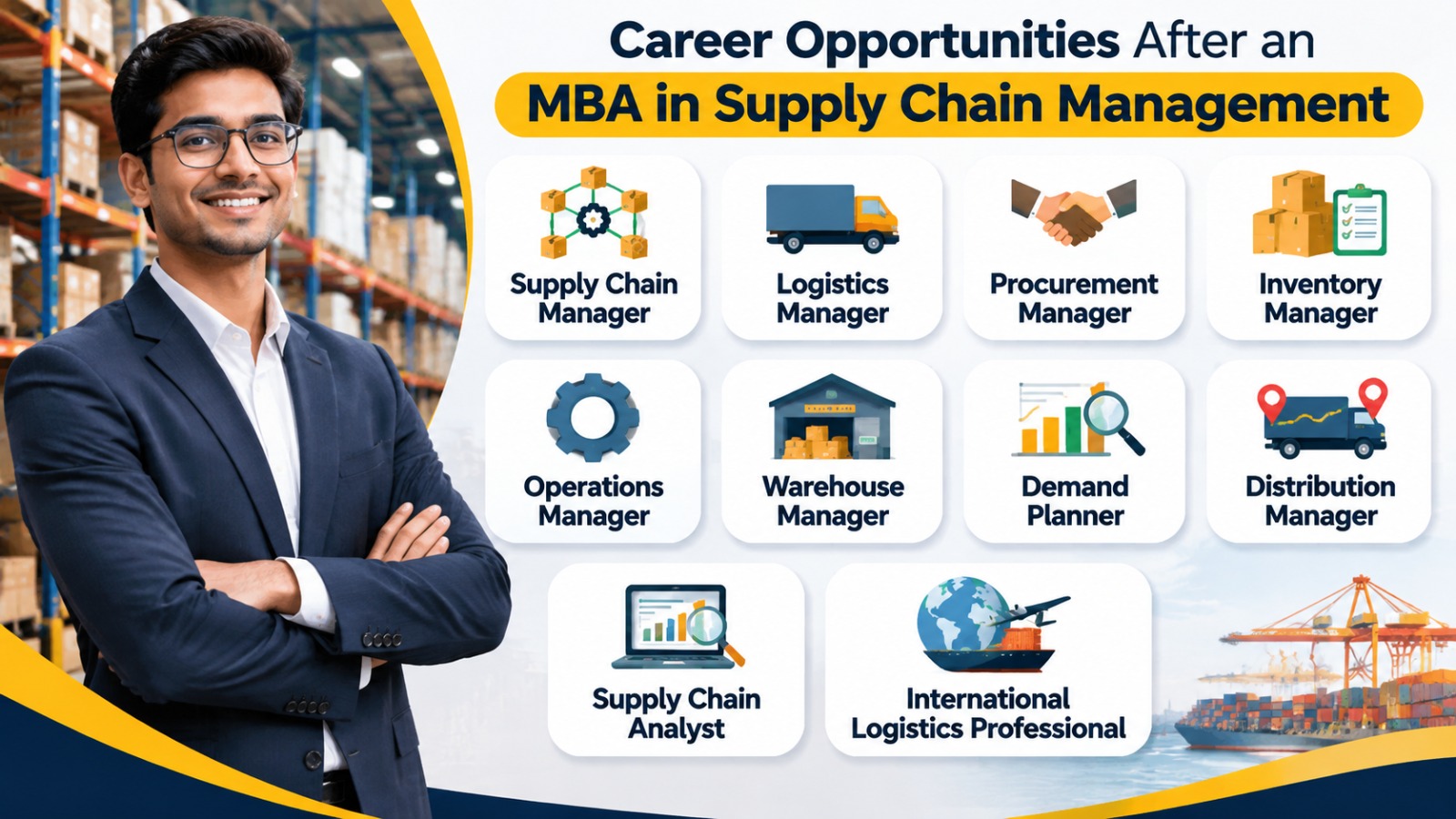
One of the interesting aspects of this specialisation is the variety of industries that depend on supply chain professionals.
A graduate may work in a manufacturing company, an e-commerce business, a retail organisation, a logistics provider or an international trading company. The responsibilities will differ, but the underlying objective remains similar: ensuring that business operations run efficiently.
Here are some career paths students can explore.
Supply Chain Manager
Supply Chain Managers oversee different stages of the supply network. Their responsibilities may include coordinating suppliers, monitoring inventory, managing distribution and identifying opportunities to improve operational performance.
The role generally requires relevant industry experience, as it involves coordinating multiple teams and making important operational decisions.
Logistics Manager
Logistics Managers are responsible for planning and coordinating the movement and storage of goods.
They may manage transportation partners, delivery schedules, distribution networks and logistics costs. Their work is particularly important for organisations handling large volumes of products.
Procurement Manager
Procurement Managers oversee the purchasing of materials, products and services required by an organisation.
They work with suppliers, negotiate commercial terms, evaluate vendor performance and help ensure that purchases meet quality and cost expectations.
Inventory Manager
Inventory Managers monitor stock levels and help businesses maintain the right balance between product availability and storage costs.
They may use inventory reports, demand forecasts and stock management systems to decide when products should be reordered and how inventory should be distributed.
Operations Manager
Operations Managers focus on the processes that allow a business to function effectively.
Depending on the organisation, they may oversee production activities, resource planning, quality control, process improvement and coordination between departments.
Warehouse Manager
Warehouse Managers supervise the storage, handling and movement of goods within a facility.
Their responsibilities can include managing warehouse staff, monitoring stock accuracy, organising storage space, overseeing order fulfilment and maintaining safety standards.
Demand Planner
Demand Planners analyse historical sales, market information and other business data to estimate future product requirements.
Their forecasts help organisations plan purchasing, production and inventory levels. The role is particularly relevant in retail, FMCG, manufacturing and e-commerce.
Distribution Manager
Distribution Managers coordinate how finished products move from warehouses or manufacturing facilities to retailers, businesses or customers.
They work to improve delivery efficiency, manage distribution partners and ensure that products reach their destinations according to business requirements.
Supply Chain Analyst
Supply Chain Analysts use data to examine operational performance and identify areas for improvement.
They may study transportation costs, supplier reliability, inventory turnover, delivery performance and demand patterns. Analytical ability and familiarity with reporting tools can be useful in this role.
International Logistics Professional
Businesses involved in international trade require professionals who understand cross-border movement, freight coordination, documentation and international logistics processes.
This career path may involve working with shipping companies, freight forwarders, exporters, importers and global supply chain teams.
The actual roles available to graduates depend on their experience, skills, programme exposure and the recruitment requirements of individual employers. Some managerial positions also require prior industry experience.
Which Industries Hire Supply Chain Management Graduates?
Supply chain management is not limited to logistics companies. It is relevant wherever products, materials or resources need to be sourced, stored, produced or delivered.
E-commerce: Online retail businesses depend on inventory planning, warehouse operations, order processing and last-mile delivery. Efficient supply chains help them meet customer expectations.
Manufacturing: Factories need a steady supply of raw materials, components and equipment. Supply chain professionals coordinate purchasing, production schedules and distribution.
FMCG: Companies dealing in food, beverages, personal care and household products manage high volumes of goods with frequent inventory movement. Planning and distribution are central to their operations.
Retail: Retail businesses must maintain product availability across stores and online channels. Inventory management and distribution planning help them respond to changing customer demand.
Automotive: The automotive industry depends on complex supplier networks and the timely availability of components. Supply chain coordination is essential for keeping production on schedule.
Pharmaceuticals and healthcare: Medicines, medical equipment and healthcare supplies require careful procurement, storage and distribution. Reliability and compliance are especially important in this sector.
Logistics and transportation: Third-party logistics providers, shipping companies and freight operators recruit professionals for planning, operations, procurement and distribution-related roles.
International trade: Importers, exporters and global businesses need professionals who can coordinate suppliers, transportation partners and cross-border logistics activities.
This variety gives students the opportunity to explore industries that match their interests rather than being restricted to one type of organisation.
Who Can Apply for an MBA in Supply Chain Management?
Eligibility requirements depend on the college and the university awarding the degree.
Generally, applicants need a bachelor's degree from a recognised university. Many institutions accept graduates from different academic backgrounds, including commerce, science, engineering, arts and business administration.
Some colleges may specify minimum qualifying marks, entrance examinations, interviews or other admission requirements.
Students should check the following before applying:
- Whether graduation in any discipline is accepted.
- The minimum marks or CGPA required.
- Whether final-year students can apply.
- Whether an entrance test is part of the selection process.
- The duration and structure of the programme.
- The recognition and accreditation of the degree-awarding university.
You do not necessarily need previous experience in logistics or operations to study this specialisation. However, an interest in how businesses function, how products reach customers and how operational problems are solved can make the subject more engaging.
Is an MBA in Logistics and Supply Chain Management Different?
The terms Logistics Management and Supply Chain Management are closely related, but they do not mean exactly the same thing.
Logistics primarily focuses on the movement, storage and distribution of goods. It deals with activities such as transportation, warehousing, freight coordination and delivery management.
Supply Chain Management has a wider scope. It includes logistics but also covers procurement, supplier relationships, demand planning, production coordination, inventory management and the overall flow of information and materials.
For example, a logistics professional may focus on finding an efficient way to transport products from a warehouse to a retailer. A supply chain professional may look at the entire process, including where the products should be manufactured, which suppliers should provide the materials, how much inventory should be maintained and how distribution should be organised.
Some MBA programmes combine both areas under a specialisation such as Logistics and Supply Chain Management. Students should review the syllabus to understand how much attention is given to each subject.
How Technology Is Changing Supply Chain Management
Supply chain operations have become increasingly dependent on technology.
Earlier, businesses often relied on manual records, phone calls and spreadsheets to coordinate purchasing, inventory and transportation. These methods still have their uses, but larger and more complex supply networks require better visibility and faster access to information.
Today, organisations use technology to monitor stock, track shipments, forecast demand and coordinate activities across different locations.
Some important developments include:
Artificial intelligence and predictive analytics: These technologies can help businesses analyse demand patterns, identify potential disruptions and improve forecasting.
Internet of Things (IoT): Connected devices and sensors can provide information about the location and condition of goods during transportation and storage.
Warehouse automation: Automated systems can support inventory movement, order picking and warehouse operations, helping businesses improve efficiency.
Enterprise Resource Planning (ERP): ERP systems bring different business functions together, allowing organisations to manage information related to purchasing, inventory, production, finance and operations.
Digital supply chain platforms: These tools improve communication and visibility between suppliers, manufacturers, distributors and other business partners.
Students who develop an understanding of these technologies may be better prepared to work in modern supply chain environments. They do not need to become software developers, but they should understand how digital tools support operational decisions.
Why Sustainability Is Becoming Part of Supply Chain Education
Supply chains have an environmental and social impact.
The transportation of goods consumes fuel, warehouses use energy, packaging creates waste and manufacturing depends on natural resources. Businesses are increasingly examining these activities as part of their sustainability goals.
This has encouraged greater attention towards responsible sourcing, efficient transportation, waste reduction, recyclable packaging and better resource utilisation.
For supply chain professionals, sustainability is becoming a practical business consideration rather than just a discussion in corporate reports.
A company may need to evaluate whether a supplier follows responsible practices, whether a delivery route can be made more efficient or whether packaging materials can be reduced without affecting product safety.
Understanding these considerations can help students develop a broader perspective on how supply chains should operate in the future.
How to Choose the Right MBA College for Supply Chain Management
Not every MBA programme offers the same learning experience. Some focus heavily on academic concepts, while others place greater emphasis on practical assignments, industry exposure and workplace learning.
When comparing colleges, look at the following factors.
Curriculum relevance: Check whether the syllabus covers procurement, logistics, inventory, operations, demand forecasting and supply chain strategy. Exposure to analytics and technology is also worth considering.
Practical learning: Look for case studies, operational assignments, internships, simulations and live projects. These activities help students understand how supply chain decisions affect businesses.
Industry interaction: Guest lectures, workshops and interactions with professionals can introduce students to actual operational challenges and industry expectations.
Faculty experience: Consider whether the faculty can connect management concepts with practical business situations.
Placement assistance: Explore the types of companies recruiting graduates, the roles offered and the career guidance provided by the institution. Look at placement information carefully rather than relying only on advertised salary packages.
Degree recognition: Verify the university awarding the MBA degree and check its recognition and accreditation status.
A good college should provide more than a qualification. It should help students understand the industry, develop relevant skills and prepare for professional responsibilities.
How GEMS B School Approaches Supply Chain Management Education
For students who prefer learning through practical involvement, the structure of an MBA programme can be an important deciding factor.
GEMS B School offers Logistics and Supply Chain Management as a specialisation under its Industry Synergised MBA programme. Its work-study model combines weekday industry engagement with weekend classroom learning, following an approximately 70% practical and 30% theoretical learning structure.
The programme is designed to connect management education with professional experience. Students get an opportunity to understand how business functions operate while developing their academic knowledge.
The institution's MBA programme is structured over two years and offers specialisations across multiple management disciplines. Its current programme information also describes the degree as being awarded by a UGC-recognised, NAAC A-grade university.
For someone interested in supply chain management, this approach can be particularly relevant because the field involves coordinating real operations, understanding workplace processes and responding to practical business requirements.
Students considering admission should confirm the latest specialisation syllabus, work-placement arrangements, eligibility criteria, university details and fee structure directly with the admissions team.
You can explore the GEMS B School MBA programme to learn more.
What Does the Future Hold for Supply Chain Professionals?
Supply chain management is evolving alongside changes in consumer behaviour, technology and international business.
Customers expect faster deliveries and greater product availability. Businesses want better control over costs and inventory. Manufacturers are exploring automation, while retailers are working towards more connected online and offline distribution systems.
At the same time, organisations are paying closer attention to supplier reliability, sustainability and the ability to respond to unexpected disruptions.
These developments are changing the responsibilities of supply chain professionals. The role is no longer limited to coordinating transportation or monitoring warehouse stock. It increasingly involves analysing information, planning resources, evaluating suppliers and supporting wider business decisions.
Students who combine management knowledge with analytical ability, technology awareness and practical experience can build a strong foundation for careers in this field.
The most valuable quality, however, may be the willingness to keep learning. Supply chain systems will continue to change, and professionals who adapt to those changes will be better prepared for new opportunities.
Conclusion
An MBA in Supply Chain Management offers a way to understand the business activities that connect suppliers, manufacturers and customers. It brings together logistics, procurement, inventory, operations, distribution and technology, making it relevant across several industries.
For students who enjoy planning, coordination, analytical thinking and solving operational problems, this specialisation can open up a variety of career possibilities.
Choosing the right college is an important part of the journey. Look beyond the programme title and examine the curriculum, practical exposure, faculty, industry connections, internships and placement support.
A management degree can provide the academic foundation, but the ability to apply that knowledge in real business situations is what helps professionals grow. With the right combination of education, experience and continuous learning, students can prepare themselves for the changing world of supply chain management.
Frequently Asked Questions
1. What is an MBA in Supply Chain Management?
An MBA in Supply Chain Management is a postgraduate programme that focuses on procurement, logistics, inventory, transportation, operations and distribution. It prepares students to understand and manage the movement of goods, materials and information across business networks.
2. What are the subjects covered in an MBA in Supply Chain Management?
Common subjects include Supply Chain Management, Logistics and Transportation, Procurement Management, Inventory Management, Operations Management, Warehousing, Business Analytics, Demand Forecasting and Global Supply Chain Management. The syllabus varies by institution.
3. Who is eligible for an MBA in Supply Chain Management?
Graduates from recognised universities can generally apply, subject to the admission requirements of the institution. Many colleges accept students from different academic backgrounds, including commerce, engineering, science and business administration.
4. What jobs can I get after an MBA in Supply Chain Management?
Graduates can explore roles such as Supply Chain Analyst, Logistics Manager, Procurement Executive, Inventory Manager, Operations Manager, Warehouse Manager, Demand Planner and Distribution Manager. Opportunities depend on experience, skills and employer requirements.
5. Is an MBA in Supply Chain Management a good career option?
It can be a promising choice for students interested in business operations, logistics, procurement and planning. Supply chain functions are important across manufacturing, retail, e-commerce, healthcare, FMCG and several other industries.
6. What is the difference between Logistics and Supply Chain Management?
Logistics mainly focuses on the transportation, storage and distribution of goods. Supply Chain Management has a wider scope, covering procurement, supplier relationships, production planning, inventory, logistics and coordination across the entire supply network.
7. Does an MBA in Supply Chain Management require technical knowledge?
Prior technical knowledge is generally not compulsory for admission to many MBA programmes. Students learn management and operational concepts during the course. An interest in technology, data analysis and business processes can be helpful.
8. Why is practical exposure important in Supply Chain Management education?
Practical exposure helps students understand procurement, inventory control, transportation planning, warehouse operations and supplier coordination in real business environments. Internships, case studies and live projects can help develop workplace confidence and problem-solving skills.