
MBA in Human Resource Management: Subjects, Skills, Salary and Job Opportunities
A company may have an excellent product, a strong business strategy and access to the latest technology. But none of these things can deliver results without the people who make the organisation work.
Think about what happens when a business hires someone new. There are interviews to conduct, responsibilities to explain, documents to complete and training to organise. Once the employee joins, the organisation must also consider performance, career development, workplace relationships and long-term engagement.
These responsibilities are part of Human Resource Management, commonly known as HR.
The role of HR has changed considerably over the years. It is no longer limited to recruitment, attendance records or handling employee paperwork. HR professionals now contribute to workforce planning, organisational development, talent management, employee experience and business strategy.
For students who enjoy working with people and understanding how organisations function, an MBA in Human Resource Management can be an interesting management specialisation.
The programme combines core business knowledge with specialised learning about recruitment, employee relations, performance management, training, compensation and organisational behaviour.
But what does studying HR actually involve? Which subjects should you expect? What career opportunities can you explore after graduation? And how should you choose an MBA HR college in Bangalore?
Let's look at these questions in detail.
Why Is Human Resource Management Important for Businesses?
Every organisation depends on people to achieve its objectives. Hiring the right employees is important, but managing their development and performance is equally necessary.
Consider a company that is expanding into a new city. It needs to identify the roles required, recruit suitable candidates, prepare teams, establish reporting structures and make sure employees understand their responsibilities.
The HR department plays an important role in coordinating these activities.
The same applies when an organisation introduces new technology, changes its working structure or plans to improve employee performance. HR professionals help businesses manage these transitions while considering the needs of their workforce.
Their responsibilities can include:
- Recruiting and selecting employees.
- Managing onboarding and employee records.
- Planning training and development.
- Supporting performance reviews.
- Managing compensation and benefits.
- Addressing workplace concerns.
- Improving employee engagement.
- Supporting organisational policies and compliance.
These activities influence how effectively an organisation attracts, develops and retains its people.
This is why HR is considered an important business function rather than simply an administrative department.
What Is an MBA in Human Resource Management?
An MBA in Human Resource Management is a postgraduate management programme that focuses on managing people and developing effective workplace systems.
The course introduces students to general business management before exploring specialised HR subjects. This helps them understand how workforce decisions connect with finance, operations, marketing and an organisation's overall strategy.
For example, when a business plans to hire more employees, HR must work with department heads to understand the positions required. The finance team may need to approve the budget, while managers must identify the skills and experience needed for each role.
This shows why HR professionals need an understanding of the wider business environment.
An MBA in HR develops knowledge in areas such as recruitment, employee relations, organisational behaviour, labour laws, training, performance management and compensation planning.
The programme can be relevant to fresh graduates as well as working professionals who want to build or advance a career in human resources.
What Do You Study in an MBA HR Programme?
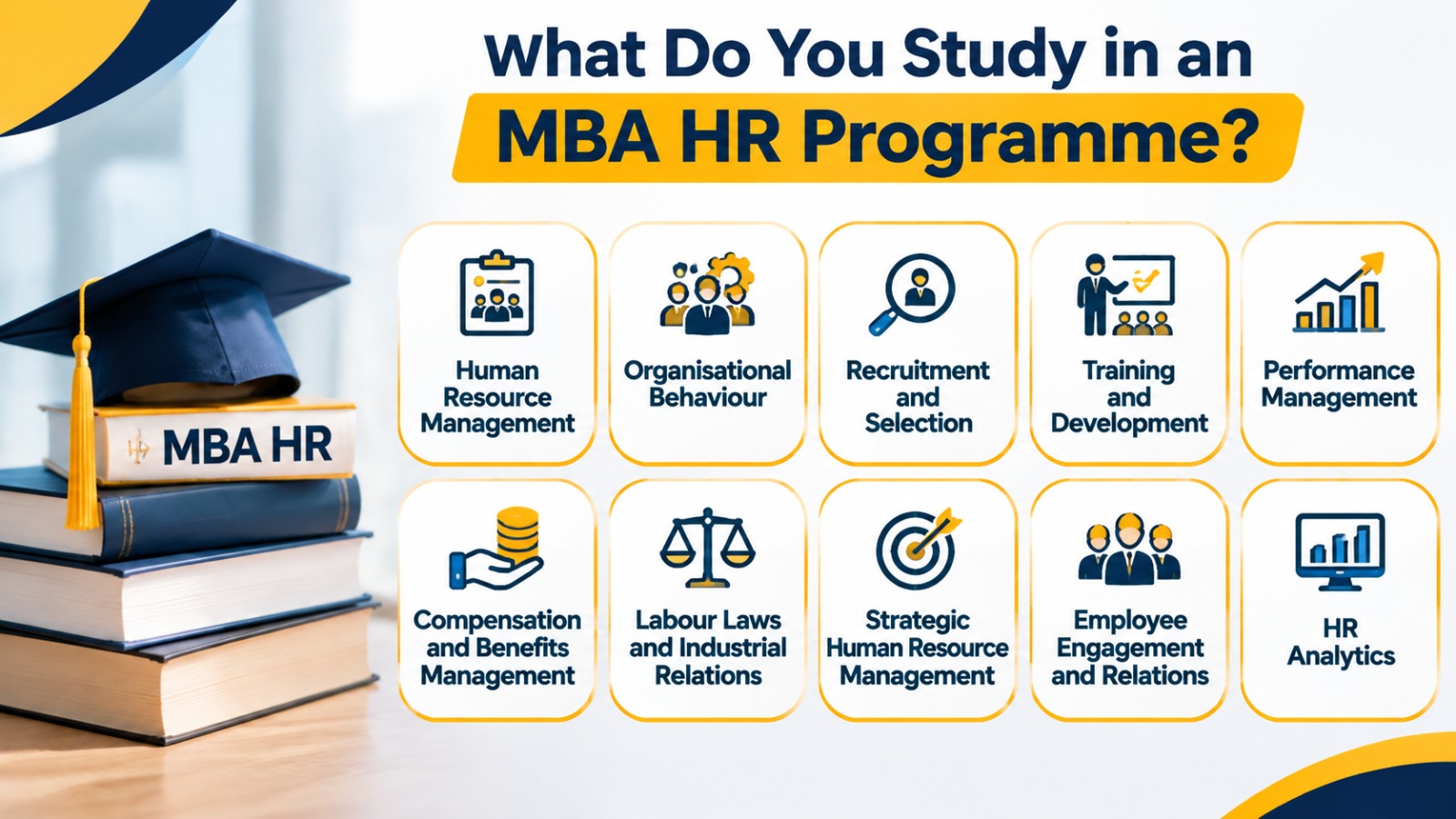
The exact syllabus varies between institutions, but most programmes combine core management subjects with specialised human resource topics.
Here are some of the key areas students may study.
1. Human Resource Management
This subject introduces students to the responsibilities and functions of an HR department.
Students explore recruitment, workforce planning, employee records, performance management, compensation and employee development.
It provides an understanding of how HR policies and practices support organisational objectives.
2. Organisational Behaviour
Why do some teams work well together while others struggle with communication? What influences employee motivation? How do leadership styles affect workplace performance?
Organisational Behaviour examines questions like these.
Students learn about individual behaviour, group dynamics, workplace culture, leadership, motivation, communication and conflict management.
The subject helps future HR professionals understand the human side of business operations.
3. Recruitment and Selection
Hiring is one of the most visible responsibilities of an HR team.
This subject introduces students to job analysis, preparing job descriptions, sourcing candidates, screening applications, conducting interviews and evaluating applicants.
Students also learn why recruitment should be based on role requirements, organisational needs and fair selection practices.
4. Training and Development
Recruiting talented employees is only one part of workforce management. Organisations must also help their employees improve their skills.
Training and Development focuses on identifying learning requirements, designing training programmes, organising development activities and evaluating their effectiveness.
Students explore how businesses prepare employees for changing responsibilities and future leadership positions.
5. Performance Management
Organisations need ways to understand whether employees are meeting their responsibilities and contributing to business goals.
Performance Management introduces students to goal setting, performance reviews, feedback, evaluation methods and improvement planning.
The subject also explores how managers can create a workplace where employees understand expectations and receive useful guidance.
6. Compensation and Benefits Management
Salary structures, incentives, bonuses and employee benefits influence recruitment and retention.
This subject introduces students to compensation planning, salary structures, reward systems, benefits administration and pay-related considerations.
It helps students understand how organisations develop compensation practices that are competitive, fair and aligned with business requirements.
7. Labour Laws and Industrial Relations
HR professionals need to understand the legal and regulatory environment surrounding employment.
Students may study employment-related legislation, workplace policies, industrial relations, employee rights and employer responsibilities.
The specific laws covered depend on the university syllabus and applicable regulatory requirements.
8. Strategic Human Resource Management
HR decisions can influence an organisation's long-term direction.
Strategic Human Resource Management examines how workforce planning, talent development, leadership and organisational culture contribute to business performance.
Students learn to connect HR activities with wider organisational objectives rather than treating them as isolated administrative tasks.
9. Employee Engagement and Relations
Employees are more likely to contribute effectively when they understand their roles, feel heard and have access to a supportive work environment.
This subject explores employee communication, workplace relationships, engagement initiatives, grievance handling and conflict resolution.
It helps students understand how organisations can build healthier professional relationships.
10. HR Analytics
Modern HR teams increasingly use data to understand workforce trends and support decisions.
HR Analytics introduces students to information such as employee turnover, recruitment timelines, attendance, performance indicators and training outcomes.
The objective is to help HR professionals use evidence rather than rely entirely on assumptions when making workforce-related decisions.
What Job Roles Can You Explore After an MBA in HR?
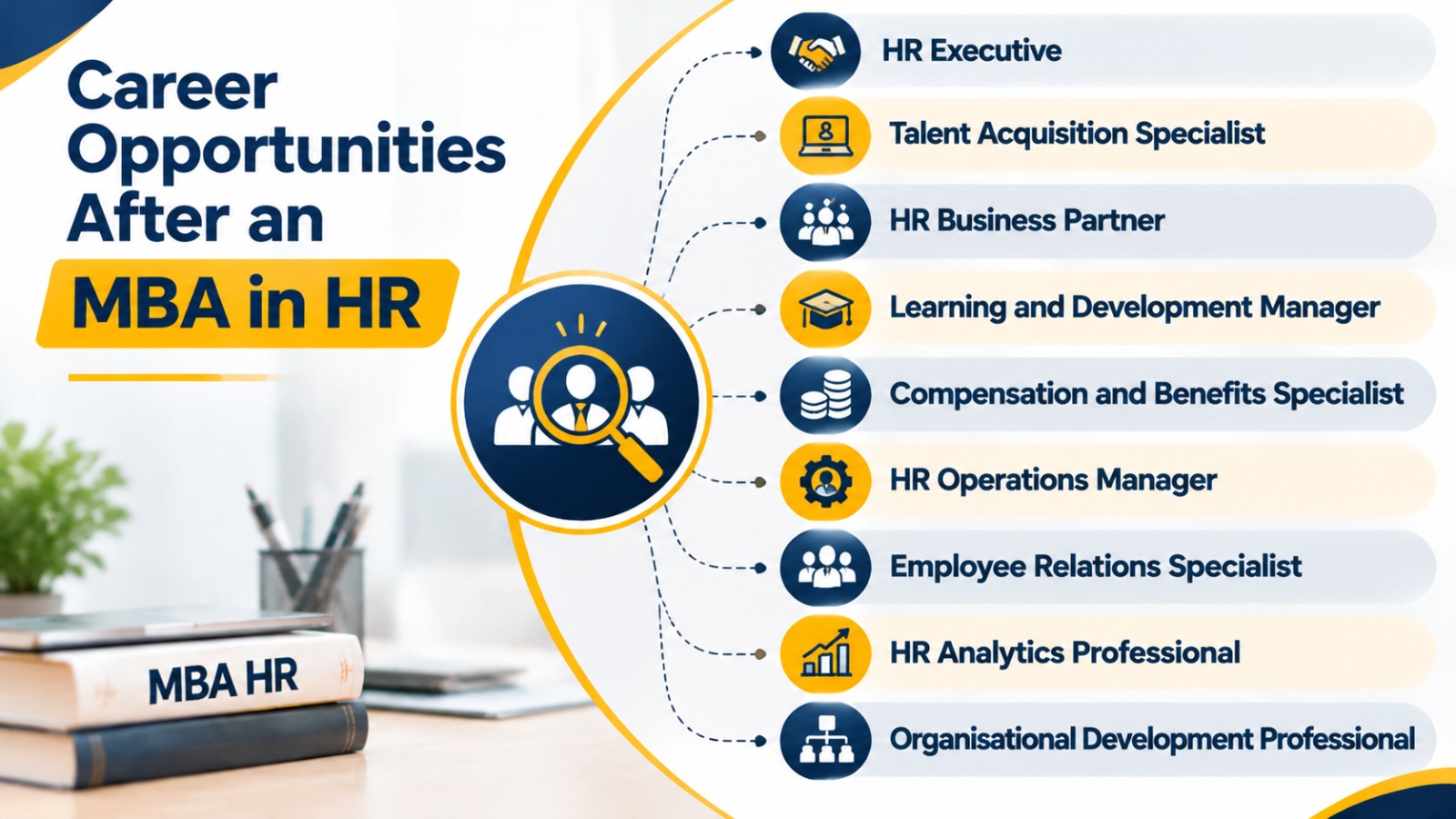
An MBA in Human Resource Management can lead to different career paths depending on the area you find most interesting. Some professionals enjoy identifying and hiring talent, while others prefer employee development, workplace policies or organisational strategy.
Here are some roles worth understanding before choosing your specialisation.
HR Executive
HR Executives support the day-to-day functioning of the human resources department. Their work may include maintaining employee records, coordinating interviews, managing onboarding documentation, supporting payroll activities and responding to employee queries.
This is a common starting point for graduates entering the HR profession.
Talent Acquisition Specialist
Talent Acquisition Specialists focus on finding and hiring suitable candidates for an organisation.
Their responsibilities can include understanding hiring requirements, sourcing profiles, screening applications, scheduling interviews and coordinating with hiring managers.
As they gain experience, they may move into recruitment leadership or specialised talent acquisition roles.
HR Business Partner
An HR Business Partner works closely with business leaders and department heads to align people-related decisions with organisational goals.
The role may involve workforce planning, employee engagement, performance improvement, leadership support and organisational development.
It usually requires a good understanding of both HR practices and business operations, along with relevant professional experience.
Learning and Development Manager
Learning and Development professionals help employees improve their knowledge and workplace capabilities.
They identify training needs, coordinate development programmes, evaluate learning outcomes and support employee growth.
This role can be particularly suitable for people who enjoy teaching, mentoring and helping others develop professionally.
Compensation and Benefits Specialist
Compensation and Benefits Specialists work on salary structures, employee benefits, incentives and reward policies.
They help organisations develop compensation practices that are competitive while remaining aligned with budgets and internal policies.
The role requires analytical ability, attention to detail and an understanding of compensation-related regulations.
HR Operations Manager
HR Operations Managers oversee processes that support the employee lifecycle. These can include onboarding, employee records, payroll coordination, HR systems, documentation and internal service delivery.
The position involves improving processes so that HR activities are organised, accurate and efficient.
Employee Relations Specialist
Employee Relations Specialists work on workplace relationships, employee concerns, grievance procedures and conflict resolution.
They help organisations address workplace issues fairly while supporting a professional and respectful environment.
Knowledge of employment policies, communication and applicable labour laws is particularly useful in this area.
HR Analytics Professional
HR Analytics professionals use workforce information to support better decisions.
They may examine employee turnover, recruitment performance, workforce costs, attendance patterns and training outcomes. The role is a good example of how data is becoming part of modern HR practice.
Organisational Development Professional
Organisational Development professionals focus on improving how an organisation functions.
Their work may involve leadership development, change management, workplace culture, team effectiveness and organisational restructuring.
The role often requires experience and a broader understanding of business strategy.
What Is the Salary After an MBA in Human Resource Management?
Salary is naturally an important consideration when choosing a management specialisation. However, there is no single salary figure that applies to every MBA HR graduate.
Compensation depends on several factors, including the job role, employer, location, academic background, practical experience and the skills a candidate brings to the position.
A graduate starting as an HR Executive may have a different salary from someone entering a specialised talent acquisition or HR analytics role. Professionals who move into management and strategic HR positions can see different compensation levels as their responsibilities increase.
For a broad idea of the market, Hyring's 2026 salary model estimates a median annual CTC of approximately ₹4.9 lakh for HR Executives in Bengaluru and ₹10.6 lakh for HR Managers in the city. These figures represent different job levels and should not be interpreted as guaranteed salaries for MBA graduates.
Actual offers can fall below or above these estimates. Students should compare salaries for the specific role and experience level they are targeting rather than relying on a general MBA placement figure.
A few factors can influence salary growth:
- Specialised skills: Knowledge of HR analytics, talent acquisition, compensation management and HR technology can help candidates qualify for specialised positions.
- Practical experience: Internships and workplace exposure can help students understand professional responsibilities.
- Industry: Technology companies, financial services, consulting firms, manufacturing businesses and other sectors may have different HR requirements and pay structures.
- Location: Bengaluru, Mumbai, Hyderabad and Delhi NCR have sizeable corporate employment markets, but living costs and salary levels also vary.
- Career progression: HR professionals can move from operational responsibilities into specialist, managerial and strategic roles as they gain experience.
The more useful question is not simply how much an MBA HR graduate earns immediately after graduation, but what skills and experience will help them progress over the next few years.
Why Is Bengaluru an Interesting City for MBA HR Aspirants?
Bengaluru is known for its technology companies, startups, multinational organisations and global capability centres. This business environment creates a varied corporate landscape in which HR teams support different types of workforces.
A technology company may need talent acquisition professionals who understand specialised hiring requirements. A growing startup may require HR generalists who can establish policies and employee processes. A large organisation may have separate teams for compensation, learning and development, employee relations and HR analytics.
This variety can make Bengaluru an interesting location for students considering an MBA HR programme.
The city also offers exposure to different organisational cultures and business models. Students can learn how people-management requirements differ between a startup, a manufacturing company and a large multinational organisation.
When searching for an MBA HR Bangalore programme, however, location should not be the only deciding factor. Compare the curriculum, faculty, industry exposure, admission requirements, internship opportunities and placement support offered by each institution.
A college's ability to connect students with relevant professional environments is worth examining alongside its academic reputation.
How Technology and AI Are Changing Human Resource Management
HR is becoming increasingly technology-driven. Tasks that once required extensive manual coordination can now be supported by specialised software and automated systems.
Recruitment platforms can help organise applications. HR information systems maintain employee records. Learning platforms support employee training, while analytics tools help HR teams study workforce trends.
Artificial intelligence is adding another dimension to these changes.
For example, AI-powered tools can assist with drafting job descriptions, organising recruitment information, answering routine employee questions and analysing workforce data. These tools can save time, but they also need appropriate human oversight.
Recruitment decisions, performance evaluations and employee-related matters require fairness, context and accountability. Technology should support these decisions rather than replace responsible human judgement.
This is why future HR professionals should be comfortable working with digital tools while understanding the ethical and practical considerations involved.
Students who develop knowledge of HR technology, data interpretation and people management may be better prepared for the changing expectations of employers.
What Should You Look for When Choosing an MBA HR College?
Choosing an MBA college is a significant decision, and the programme should match both your learning preferences and career objectives.
A few areas deserve particular attention.
Curriculum: Check whether the programme covers recruitment, organisational behaviour, training, compensation, labour laws, performance management and HR analytics.
Faculty: Look at the academic and professional experience of faculty members. Their ability to connect concepts with workplace situations can make learning more meaningful.
Industry exposure: Ask whether students participate in internships, corporate projects, workshops or interactions with working HR professionals.
Practical assignments: HR involves real situations that cannot always be understood through theory alone. Case studies, interview exercises, recruitment assignments and organisational projects can be useful.
Placement support: Find out which kinds of companies recruit students, what roles are offered and how the institution prepares students for interviews.
University recognition: Verify the university awarding the MBA degree and review the programme's recognition and accreditation details.
Learning format: Understand whether the course is full-time, part-time or work-integrated. Make sure the schedule and responsibilities are suitable for your circumstances.
It is also helpful to speak with current students or alumni. Their feedback can give you a clearer understanding of the actual learning environment.
How GEMS B School Connects HR Education with Industry Experience
For students comparing MBA HR colleges in Bangalore, the way a programme connects academic learning with professional experience can be an important consideration.
GEMS B School offers Human Resource Management as one of the specialisations under its two-year Industry Synergised MBA programme. Its work-study model follows a weekday industry engagement and weekend classroom format, with approximately 70% practical learning and 30% classroom-based learning.
The programme is designed around the idea that management concepts become easier to understand when students can relate them to professional situations. Instead of approaching business functions only through classroom discussions, students get an opportunity to experience workplace responsibilities alongside their studies.
For HR aspirants, this approach can help build familiarity with organisational processes, workplace communication and the expectations of professional teams.
GEMS B School's programme information states that students complete an MBA degree awarded by a UGC-recognised, NAAC A-grade accredited Indian university, along with a PGP certification from GEMS B School. The institution also describes its programme as offering full-time work placement support related to the chosen specialisation.
The institution's website features student experiences from its HR programme, including graduates who have secured opportunities at organisations such as KPMG Delivery Network India. These are individual student outcomes, not a guarantee of placement for every applicant.
Students considering the programme should confirm the current HR work-placement arrangements, admission process, degree-awarding university, fee structure and specific specialisation curriculum directly with the admissions team.
You can explore the GEMS B School Industry Synergised MBA programme for further details.
What Does the Future of Human Resource Management Look Like?
The expectations from HR teams are changing as organisations rethink how they hire, develop and retain employees.
Hybrid working arrangements, changing employee expectations, digital recruitment and the growing use of workforce analytics are influencing people-management practices.
At the same time, organisations need to address questions around employee well-being, workplace culture, leadership development, inclusion and professional growth.
This means HR professionals increasingly need to understand the business behind the people function.
For example, when a company experiences high employee turnover, the solution may not simply be to hire more people. HR teams may need to examine management practices, compensation, workload, career development opportunities and employee feedback to understand what is happening.
Similarly, when a business adopts new technology, employees may require training and support to adjust to new responsibilities.
These situations show why HR needs a combination of people skills, analytical thinking and business understanding.
An MBA can provide a foundation in these areas. Building practical experience and keeping up with changes in the workplace will help professionals develop further throughout their careers.
Conclusion
An MBA in Human Resource Management is a suitable option for students who want to understand how organisations recruit, develop and manage their people. It combines business education with specialised knowledge of recruitment, employee relations, performance management, compensation, training and organisational development.
The career opportunities extend beyond traditional HR administration. Graduates can explore talent acquisition, HR operations, learning and development, compensation management, HR analytics and strategic people-management roles.
For students considering an MBA HR programme in Bangalore, it is worth looking beyond the college name and comparing the actual learning experience. Examine the curriculum, faculty, practical exposure, industry connections and placement support before making a decision.
Human Resource Management is ultimately about understanding people within the context of business. A good management programme should help students develop that perspective while preparing them to handle the professional responsibilities of the field.
The organisations of tomorrow will need people who can understand both business goals and employee needs. Developing the ability to bring these two sides together can be a meaningful starting point for a career in HR.
Frequently Asked Questions
1. What is an MBA in Human Resource Management?
An MBA in Human Resource Management is a postgraduate programme that focuses on managing employees and developing effective workplace practices. It covers recruitment, training, performance management, compensation, employee relations and organisational development.
2. What are the main subjects in an MBA HR programme?
Common subjects include Human Resource Management, Organisational Behaviour, Recruitment and Selection, Training and Development, Performance Management, Compensation and Benefits, Labour Laws, Strategic HR Management and HR Analytics.
3. Who is eligible for an MBA in Human Resource Management?
Graduates from recognised universities can generally apply, subject to the college's admission requirements. Many institutions accept students from different academic backgrounds, although minimum marks or entrance examinations may be required.
4. What jobs can I get after an MBA in HR?
Graduates can explore roles such as HR Executive, Talent Acquisition Specialist, HR Business Partner, Learning and Development Professional, Compensation and Benefits Specialist, HR Operations Manager and HR Analytics Professional.
5. What is the salary after an MBA in Human Resource Management?
Salary depends on the job role, location, employer, experience and specialised skills. Entry-level HR roles generally offer different compensation from managerial or specialist positions. Bengaluru salary estimates should be compared by role and experience rather than treated as guaranteed MBA placement packages.
6. Is an MBA in HR a good career option in Bangalore?
Bengaluru has a diverse business environment, including technology companies, startups, multinational organisations and global capability centres. These organisations require HR professionals across recruitment, employee management, learning and development and other functions. The suitability of the career depends on individual interests and skills.
7. Can students from a non-commerce background pursue an MBA in HR?
Yes. Many MBA programmes accept graduates from different academic disciplines, provided they meet the admission requirements. Students do not necessarily need a previous degree in human resources or commerce.
8. What skills are important for a successful HR professional?
Communication, interpersonal skills, problem-solving, negotiation, analytical thinking, organisation and ethical judgement are important. Familiarity with HR technology and data analytics can also be useful in modern HR roles.