

MBA in Financial Management: Course Details, Subjects, Eligibility and Career Scope
Every business decision has a financial side to it. A company considering a new product, planning to open another branch, hiring more employees or entering a different market needs to understand what the decision will cost and whether it makes financial sense.
That is where financial management becomes important.
Behind the growth of a business are professionals who study numbers, assess risks, manage budgets and help organisations decide how to use their money. Their work influences everything from daily operations to long-term business strategy.
For students who enjoy working with numbers but also want to understand how businesses function, financial management can be an interesting area of study. It brings together accounting, economics, investment decisions, financial planning and management.
An MBA in Financial Management is designed to develop this combination of knowledge. It helps students understand how financial decisions are made within organisations and how those decisions affect business performance.
But what does the course actually involve? Which subjects are covered? What career options can graduates explore? And what should students look for when comparing colleges?
Let's take a closer look.
Why Does Financial Management Matter in Every Business?
A business can have a strong product, a talented team and a growing customer base, but without sound financial planning, sustaining that growth becomes difficult.
Consider a company planning to expand its operations. Before moving ahead, it needs to estimate the investment required, understand its available funds, evaluate potential returns and consider the risks involved.
Similarly, a business that wants to introduce a new product must decide how much it can spend on production, marketing and distribution. It also needs to estimate sales, manage cash flow and monitor whether the product is generating enough revenue.
These decisions require financial understanding.
Financial management is not limited to preparing balance sheets or checking expenses. It involves analysing information, planning resources, evaluating opportunities and helping businesses make informed decisions.
This is why finance professionals work across industries, including banking, consulting, manufacturing, technology, healthcare, retail and financial services.
What Is an MBA in Financial Management?
An MBA in Financial Management is a postgraduate management programme that focuses on the financial aspects of running an organisation.
Students learn how businesses raise funds, allocate resources, manage investments, evaluate financial performance and plan for future growth.
The programme generally combines core management subjects with specialised finance topics. This gives students an understanding of how finance connects with marketing, operations, human resources and overall business strategy.
For example, a finance professional working with a retail company may be involved in budgeting, analysing operating costs, evaluating store expansion plans and monitoring profitability.
In a bank, the work may involve financial analysis, credit assessment, risk management or investment-related services.
The exact responsibilities depend on the role, organisation and level of experience.
An MBA in Financial Management can therefore be relevant to students who want to explore corporate finance, banking, financial planning, investment analysis or other business-related finance roles.
MBA in Financial Management: Course Structure and Duration
Most MBA programmes are designed as two-year postgraduate courses, although the structure and duration can vary depending on the institution and programme format.
The first part of the programme generally introduces students to the fundamentals of business management. These subjects help them understand how organisations operate and how different departments contribute to business performance.
As students progress, they study specialised finance subjects that develop their understanding of financial planning, investment decisions, accounting, corporate finance and risk.
Many institutions also include practical assignments, presentations, case studies, internships and industry interactions.
When comparing an MBA financial management course, students should examine the complete curriculum rather than focusing only on the specialisation name. A programme should help them understand both financial concepts and the business situations in which those concepts are applied.
Subjects Covered in an MBA in Financial Management

The subjects may differ between colleges, but most programmes cover a combination of management fundamentals and specialised finance topics.
1. Financial Accounting
Financial accounting introduces students to the way organisations record and report their financial activities.
Students learn to understand financial statements, including income statements, balance sheets and cash flow statements. They also explore how accounting information is used by investors, lenders, managers and other stakeholders.
A sound understanding of accounting is important because financial decisions depend on accurate information about an organisation's performance and position.
2. Corporate Finance
Corporate finance focuses on how businesses manage their funds and make financial decisions.
Students explore topics such as capital structure, financing options, investment decisions, cost of capital and dividend policies.
For instance, when a company plans to expand, it may need to decide whether to use internal funds, borrow money or attract external investment. Corporate finance helps students understand the considerations behind such decisions.
3. Financial Management
This subject introduces the principles involved in planning, organising and controlling an organisation's financial resources.
It covers areas such as budgeting, working capital management, financial planning, cash flow and resource allocation.
The objective is to help students understand how businesses maintain financial stability while working towards their growth objectives.
4. Investment Management
Investment management focuses on how individuals and organisations evaluate investment opportunities.
Students may study different asset classes, portfolio management, risk and return, investment analysis and market behaviour.
The subject provides a foundation for understanding how investment decisions are made and why risk assessment is an essential part of financial planning.
5. Financial Markets and Institutions
Financial markets connect organisations, investors, borrowers and lenders.
This subject introduces students to the functioning of financial markets and institutions, including banks, stock exchanges, mutual funds and other financial intermediaries.
Understanding these institutions helps students see how money moves through the economy and how financial systems support business activity.
6. Management Accounting
While financial accounting focuses on reporting financial information, management accounting uses that information to support internal business decisions.
Students may study cost analysis, budgeting, performance measurement and variance analysis.
These concepts help managers understand where money is being spent, whether resources are being used efficiently and what changes may be required.
7. Risk Management
Every financial decision involves some level of uncertainty.
Risk management introduces students to the process of identifying, assessing and managing financial risks. These may include credit risk, market risk, liquidity risk and operational risk.
Students learn why businesses need systems and strategies to protect their financial position while pursuing opportunities.
8. Business Economics
Business economics helps students understand how economic conditions influence organisations.
Topics may include demand and supply, inflation, interest rates, market structures, monetary policy and economic growth.
These concepts are useful when evaluating business decisions in changing economic conditions.
Skills Students Develop During an MBA in Financial Management
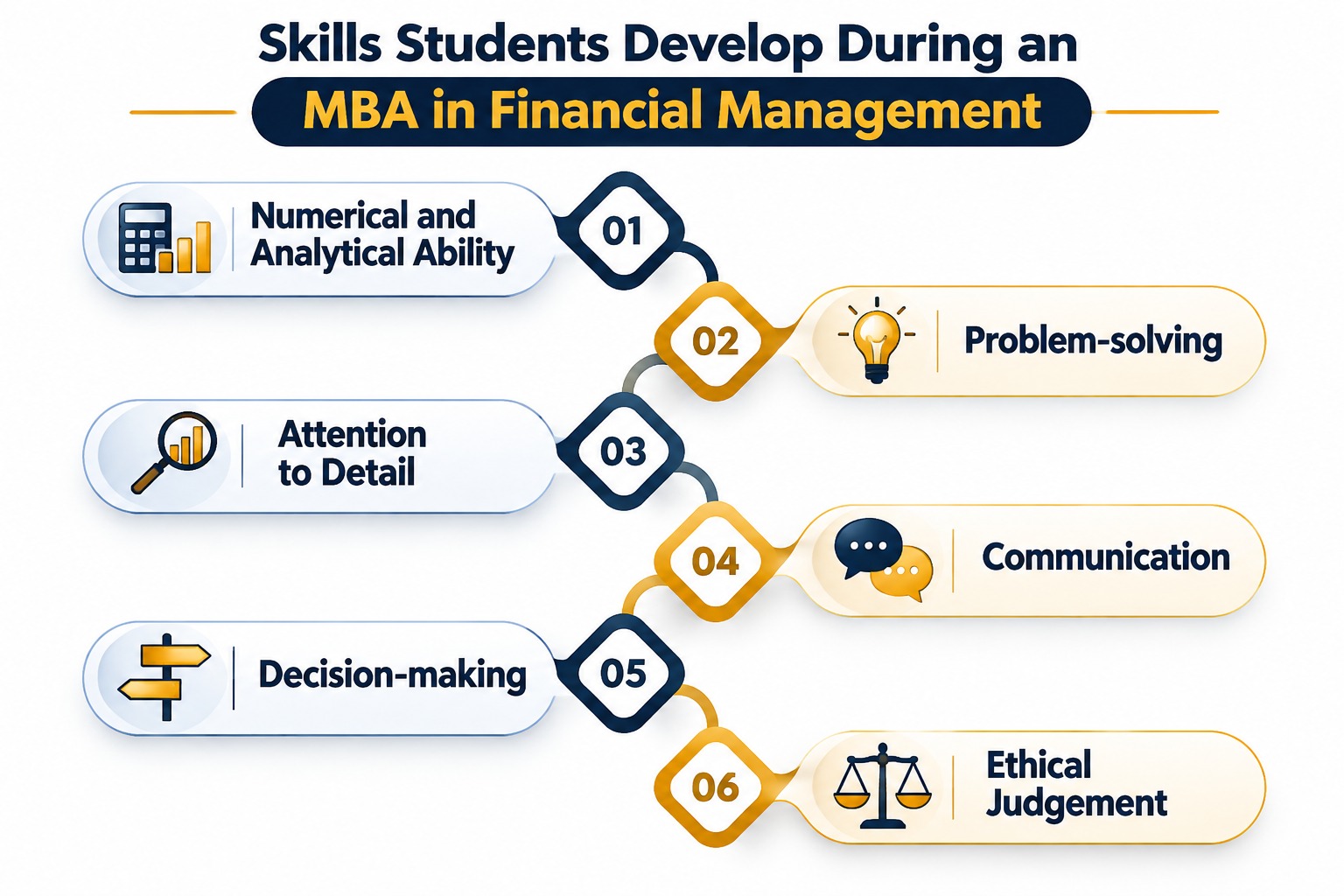
Understanding financial concepts is important, but employers also look for people who can interpret information and explain what it means for a business.
A finance professional may prepare a detailed report, but the real value lies in identifying what the numbers reveal and helping decision-makers act on that information.
An MBA in Financial Management helps students work towards developing several important capabilities.
Numerical and analytical ability: Students learn to interpret financial statements, examine business performance and work with numerical information. Comfort with numbers is useful, although the ability to understand what those numbers represent is equally important.
Problem-solving: Financial decisions rarely have only one possible answer. Professionals need to compare alternatives, consider risks and recommend practical solutions.
Attention to detail: Small errors in financial calculations or reporting can affect larger business decisions. Accuracy and careful review are essential.
Communication: Finance professionals regularly explain budgets, reports and financial recommendations to people who may not have a finance background. Clear communication makes their work more effective.
Decision-making: Organisations rely on finance teams to evaluate investment proposals, manage resources and identify financial concerns. Students develop an understanding of the factors involved in these decisions.
Ethical judgement: Financial information is sensitive, and professionals are expected to handle it responsibly. Integrity, transparency and an understanding of compliance are important in this field.
These capabilities develop through academic study, practical assignments, internships and professional experience. They also become stronger as individuals take on more responsibility in the workplace.
Who Should Consider an MBA in Financial Management?
This specialisation may suit students who are curious about how businesses manage money and make financial decisions.
You do not necessarily need to have studied finance throughout your undergraduate education. Students from commerce, economics, business administration, engineering and other academic backgrounds may be eligible, depending on the institution's admission criteria.
It can be a good area to explore if you:
- Enjoy analysing information and solving numerical problems.
- Want to understand how companies plan their finances.
- Are interested in banking, investments or corporate finance.
- Would like to work in financial planning or business analysis.
- Want to understand the financial side of management and entrepreneurship.
Students should also be comfortable with continuous learning. Financial regulations, technology, market conditions and business practices evolve, so professionals need to keep their knowledge current.
Career Opportunities After an MBA in Financial Management
Finance is not restricted to banks or stock markets. Almost every organisation needs professionals who can manage budgets, assess performance, plan resources and support financial decisions.
The roles available to graduates depend on their specialisation, practical experience, technical skills and the requirements of employers.
Financial Analyst
Financial Analysts study financial information to help organisations understand performance and evaluate business decisions.
Their work may involve analysing reports, preparing forecasts, examining expenses and assessing investment opportunities. They often present their findings to managers and other decision-makers.
Finance Manager
Finance Managers oversee important financial activities within an organisation. Depending on the company, their responsibilities may include budgeting, financial reporting, cash flow management, forecasting and financial planning.
This role generally requires relevant professional experience in addition to management education.
Investment Analyst
Investment Analysts research companies, industries and financial markets to assess investment opportunities.
They may examine company performance, market developments, financial statements and potential risks. Their analysis supports investment decisions made by individuals, institutions or fund managers.
Banking Professional
Banks offer several career paths for management graduates. Depending on the role and eligibility requirements, opportunities may be available in credit analysis, relationship management, banking operations, financial services and business development.
Some specialised banking roles may also require additional certifications or examinations.
Credit Analyst
Credit Analysts assess the ability of individuals or businesses to repay borrowed money.
They review financial statements, income details, credit history and other relevant information before supporting lending decisions. The role requires careful analysis and an understanding of financial risk.
Corporate Finance Professional
Corporate finance teams help organisations evaluate funding requirements, investment proposals and financial strategies.
Professionals in this area may work on capital budgeting, financial planning, business expansion analysis and funding decisions.
Financial Planning and Analysis Professional
Often referred to as FP&A, this area focuses on helping businesses plan and monitor their financial performance.
Professionals prepare budgets, develop forecasts, compare actual results with planned targets and explain financial variations. Their work helps management understand where the organisation stands and what may need attention.
Risk Management Professional
Risk Management professionals identify financial and operational risks that could affect an organisation.
In financial institutions, this may involve examining credit exposure, market movements, liquidity and compliance requirements. In other businesses, the role may focus on identifying financial vulnerabilities and supporting risk-control processes.
Entrepreneur or Business Consultant
An understanding of financial management is useful for people who want to start a business or work in consulting.
Entrepreneurs need to understand costs, pricing, cash flow, funding and profitability. Consultants may use financial analysis to help organisations improve their performance or evaluate business opportunities.
These roles illustrate the range of possibilities, but an MBA alone does not automatically qualify someone for every position. Employers may also consider relevant experience, technical proficiency and professional certifications.
Is an MBA in Financial Management Different from an MBA in General Management?
A general MBA provides an overview of several business functions. Students study areas such as marketing, human resources, operations, finance and strategy.
An MBA in Financial Management builds on this foundation by giving greater attention to financial decision-making.
For example, a general management student may learn how a company plans its expansion. A finance specialisation goes further into the investment required, possible funding sources, projected returns and financial risks associated with that expansion.
Both programmes can lead to management careers, but their academic focus is different.
If you want a broad understanding of business, general management may be suitable. If you are particularly interested in financial planning, investment decisions, corporate finance and financial analysis, a finance specialisation may be a better fit.
How to Choose the Right MBA Financial Management College
A programme's name may sound promising, but students should examine what the institution actually offers before applying.
Start with the curriculum. Look for a reasonable balance between core management subjects and finance-related topics. The course should help you understand the financial function as part of a larger organisation.
Next, consider how students learn. Financial management involves applying concepts to business situations, so case studies, financial exercises, projects and internships can make a meaningful difference.
Faculty experience is another factor worth checking. Ask whether students have opportunities to learn from professionals who understand the financial services industry and corporate finance environments.
It is also sensible to review placement information. Look at the kinds of roles offered, companies recruiting graduates, internship opportunities and career guidance available. Do not base your decision on a single salary figure.
Finally, understand the qualification itself. Check the degree-awarding university, recognition status, admission requirements, course duration and fee structure. If the institution offers an additional certification, find out whether it is included in the programme or involves separate requirements.
A little research at this stage can help you avoid choosing a course based only on its marketing claims.
How GEMS B School Connects Financial Management Education with Industry
For students comparing MBA colleges, the learning model deserves as much attention as the specialisation itself.
GEMS B School offers Financial Management as one of the specialisations under its Industry Synergised MBA programme. The institution follows a work-study model in which students work with partner organisations during weekdays and attend academic classes on weekends. The programme is designed around a two-year structure, with approximately 70% practical learning and 30% classroom learning.
Welcome to GEMS B School+1
The idea is to help students connect management concepts with professional experience instead of learning everything through classroom instruction alone.
The programme also includes opportunities for industry interaction and practical exposure through its employer network. GEMS B School lists more than 400 employer partners and provides placement support as part of its programme offering.
Welcome to GEMS B School
For students interested in financial management, this approach can provide a useful opportunity to understand how business functions operate in professional environments while developing their academic knowledge.
The current programme information lists eligibility for graduates from any discipline, subject to the institution's admission process. Students should confirm the latest admission requirements, financial management subject list, work-placement arrangements and fee details directly with the admissions team.
What Does the Future Look Like for Finance Professionals?
The finance function is changing. Technology has made financial information easier to access, while automation has reduced the time spent on several routine activities.
Businesses increasingly use digital systems for accounting, reporting, forecasting and financial analysis. Artificial intelligence and data analytics are also influencing how finance teams examine information and support decisions.
This does not make financial management less important. In many ways, it makes informed financial judgement even more valuable.
A professional may have access to detailed reports generated by software, but someone still needs to interpret those reports, question unusual results, identify potential risks and understand the business implications.
Finance professionals who combine financial knowledge with technology awareness, analytical thinking and communication skills can be better prepared for these changes.
There is also growing importance attached to areas such as financial compliance, risk management, corporate governance and responsible investment. These developments create opportunities for people who are willing to keep learning and adapt to new business requirements.
An MBA can provide the management foundation for this journey, while professional experience and continuous skill development help individuals progress.
Conclusion
An MBA in Financial Management is worth exploring if you want to understand how businesses plan, manage and make decisions about their financial resources. It combines management education with specialised knowledge of accounting, corporate finance, investments, financial planning and risk.
The qualification can open pathways into banking, corporate finance, financial analysis, financial planning and other business-related roles. The direction you take will depend on your interests, practical experience and the skills you develop during the programme.
Before selecting a college, look beyond the course title. Examine the subjects, faculty, learning approach, industry exposure, internship opportunities and placement support. A programme that connects financial concepts with real business situations can help you develop a stronger understanding of the profession.
Ultimately, financial management is about more than working with numbers. It is about understanding what those numbers mean, recognising opportunities and helping organisations make better decisions.
Frequently Asked Questions
1. What is an MBA in Financial Management?
An MBA in Financial Management is a postgraduate management programme that focuses on financial planning, corporate finance, accounting, investment management and risk assessment. It prepares students to understand and support financial decisions within organisations.
2. What are the main subjects in an MBA Financial Management course?
Common subjects include Financial Accounting, Corporate Finance, Financial Management, Investment Management, Financial Markets and Institutions, Management Accounting, Risk Management and Business Economics. The exact syllabus varies by institution.
3. Who is eligible for an MBA in Financial Management?
Graduates from recognised universities can generally apply, subject to the college's eligibility criteria. Some institutions accept students from any academic discipline, while others may specify minimum marks or additional admission requirements.
4. What jobs can I get after an MBA in Financial Management?
Graduates can explore roles such as Financial Analyst, Finance Manager, Credit Analyst, Investment Analyst, Financial Planning and Analysis Professional, Banking Professional and Risk Management Professional. The opportunities available depend on skills, experience and employer requirements.
5. Is an MBA in Financial Management suitable for students without a commerce background?
Yes. Students from different academic backgrounds may be eligible for the programme. They will study foundational management and finance concepts as part of the course, although an interest in numbers and analytical problem-solving can be helpful.
6. What is the difference between an MBA in Finance and an MBA in Financial Management?
The terms are often used interchangeably by institutions. Both generally focus on areas such as financial planning, corporate finance, investment decisions and financial analysis. Students should compare the actual curriculum rather than relying only on the programme title.
7. Is an MBA in Financial Management a good career choice?
It can be a suitable option for students interested in business finance, banking, investment analysis and financial planning. Finance professionals are needed across industries, although career growth depends on relevant skills, experience and continued learning.
8. How should I choose a college for an MBA in Financial Management?
Compare the curriculum, faculty experience, university recognition, practical learning opportunities, internships, industry partnerships, placement support and overall fees. It is also useful to understand how the institution connects classroom education with professional experience.