
Top Colleges for MBA in Digital Marketing: Courses, Skills and Career Opportunities
A brand launches a new product. Within minutes, its campaign appears on Instagram, a search result, a YouTube video and perhaps even in your email inbox. You might notice the advertisement, click on it, compare the product with a competitor and eventually make a purchase. What looks like a simple online interaction is actually the result of several marketing decisions working together.
Behind those decisions are professionals who understand audiences, digital platforms, consumer behaviour, content, advertising budgets and data. Their work is a big part of why digital marketing has become an important function for businesses of almost every size.
This shift has also changed what students look for when choosing a management specialisation. A traditional MBA provides a broad understanding of business, but students who are interested in online branding, customer engagement and digital business growth may want to explore a more focused programme.
That is where an MBA in Digital Marketing comes in.
The course combines management fundamentals with specialised knowledge of digital channels and marketing technology. But choosing the right college requires more thought than simply looking for a programme with Digital Marketing in its name. The curriculum, practical exposure, faculty, industry connections and career support all deserve attention.
Let's look at what students should know before choosing a college for an MBA in Digital Marketing.
Why Are Students Choosing Digital Marketing as an MBA Specialisation?
Marketing has always been about understanding people and communicating value. What has changed is where these conversations take place.
Customers now discover brands through search engines, social media, online marketplaces, video platforms, websites and digital communities. Businesses use these channels not only to promote products but also to answer questions, build relationships, understand customer preferences and encourage repeat purchases.
For companies, digital marketing is no longer limited to posting on social media or running advertisements. It involves planning campaigns, managing budgets, studying performance and making decisions based on customer data.
This creates opportunities for professionals who can connect marketing knowledge with business objectives.
An MBA in Digital Marketing is designed for students who want to understand both sides of this work. They learn the management principles that guide business decisions while developing knowledge of the digital tools and strategies used to reach modern consumers.
The specialisation can be relevant to fresh graduates as well as professionals who want to build a career in marketing, advertising, brand management or digital business development.
What Does an MBA in Digital Marketing Actually Teach?
One of the first things to understand is that an MBA in Digital Marketing is not simply a collection of short courses on online platforms.
A well-rounded programme begins with management education. Students need to understand how organisations function before they can make meaningful marketing decisions within them.
The course generally brings together two broad areas:
Management foundations: Business communication, organisational behaviour, accounting, economics, marketing management, finance and strategic management.
Digital marketing specialisation: Search engine optimisation, search engine marketing, social media marketing, content strategy, email marketing, web analytics, online advertising and digital campaign planning.
The exact subjects and their sequence differ between institutions. Some colleges also include website development, affiliate marketing, marketing automation, e-commerce and emerging technology as part of their curriculum.
The important thing is to understand whether the course teaches students to connect individual digital channels with a larger marketing strategy.
For example, knowing how to create a social media post is useful. Knowing why a brand needs that post, which audience it should reach, what action it should encourage and how its performance will be measured is a much broader management skill.
Subjects You May Study During the Programme
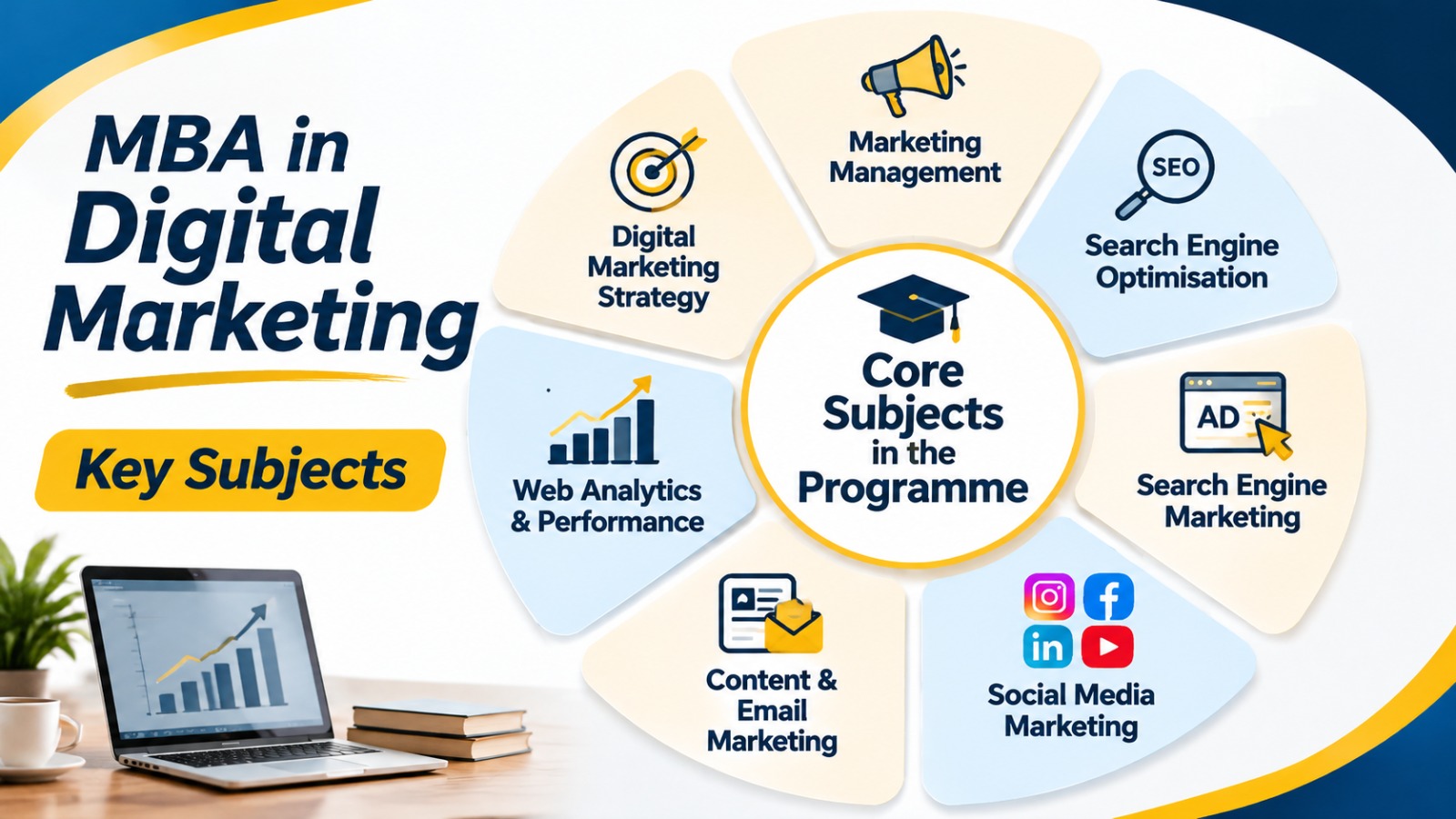
The curriculum is one of the most important factors to examine while comparing colleges for an MBA in Digital Marketing. Here are some of the areas students may encounter.
1. Marketing Management
Before studying digital campaigns, students need a clear understanding of marketing principles. This subject introduces concepts such as segmentation, targeting, positioning, branding, consumer behaviour and marketing strategy.
It helps students understand why different products require different approaches and how businesses position themselves in competitive markets.
2. Search Engine Optimisation
Search engine optimisation, commonly known as SEO, focuses on improving a website's visibility in unpaid search results.
Students may explore keyword research, website structure, content optimisation, technical SEO, search intent and performance monitoring. The subject introduces the relationship between what people search for and the information businesses publish online.
3. Search Engine Marketing
Search engine marketing introduces paid advertising on search platforms. Students learn how businesses use paid campaigns to reach people who are actively looking for particular products, services or information.
Topics can include campaign planning, keyword selection, bidding, ad copy, budget allocation and performance measurement.
4. Social Media Marketing
Social media platforms have become important spaces for brand communication and customer engagement.
This subject may cover platform selection, audience research, content planning, community management, influencer collaborations, paid social campaigns and reporting.
The objective is to understand how social platforms contribute to brand awareness, engagement, lead generation and sales.
5. Content and Email Marketing
A digital campaign needs more than visibility. It needs communication that gives people a reason to pay attention.
Content marketing explores how businesses use blogs, videos, guides, newsletters and other formats to educate audiences and build trust. Email marketing focuses on communicating with existing and potential customers through targeted messages, newsletters and automated campaigns.
Together, these subjects help students understand how brands can build relationships over time rather than relying only on one-time advertisements.
6. Web Analytics and Performance Measurement
Marketing decisions become more useful when their results can be evaluated.
Web analytics introduces students to website traffic, user behaviour, conversions, campaign performance and other measurable indicators. Students may also learn to work with analytics and reporting platforms.
The subject encourages a practical question: what does the available data tell us, and what should the business do next?
7. Digital Marketing Strategy
This subject brings the different areas of digital marketing together.
Students learn to think about campaign objectives, audience selection, channel planning, budgets, competition and performance. It helps them see digital marketing as part of an organisation's overall business strategy.
How to Identify the Right College for an MBA in Digital Marketing
A quick search for top colleges for MBA in digital marketing can produce a long list of institutions. The challenge is working out which programmes offer the kind of education and experience that will actually help you move towards your career goals.
Rather than relying on promotional claims, compare colleges across a few practical areas.
Look Closely at the Curriculum
Start by reading the subjects included in the programme. Does the course cover the fundamentals of management as well as specialised digital marketing topics? Are students introduced to analytics, paid advertising, search optimisation, content and social media strategy?
Digital platforms change frequently, so a course should also encourage students to understand new tools and developments rather than depend entirely on a fixed set of platform techniques.
A useful curriculum teaches the reasoning behind marketing decisions. Tools may change, but the ability to understand customers, plan campaigns and interpret results remains valuable.
Find Out How Much Practical Work Is Included
This is particularly important for a specialisation like digital marketing.
Students should have opportunities to work on campaign briefs, content plans, website audits, keyword research, advertising exercises and performance reports. These activities help turn classroom concepts into skills that can be used in a professional setting.
Ask the college what practical assignments students complete and whether they work on real projects or simulated business situations. If internships are part of the programme, understand their duration, structure and relevance to the specialisation.
Check the Faculty's Industry Experience
Digital marketing is closely connected to the way businesses operate. Learning from faculty members who understand both management concepts and industry practices can make classroom discussions more meaningful.
It is worth finding out whether the programme includes guest sessions, workshops or mentoring from working professionals. These interactions can give students a clearer picture of what employers expect and how marketing teams function.
Understand the Placement and Internship Support
Placement support deserves careful attention, but students should look beyond a headline salary figure.
Ask about the types of companies that recruit students, the roles offered, internship arrangements and the career guidance available during the programme.
A college should be able to explain its placement process clearly. Students should also understand that final outcomes depend on individual performance, skills, eligibility and the requirements of recruiting organisations.
Examine the Learning Environment
The way a programme is delivered can influence how much students gain from it.
Some institutions follow a conventional classroom-based format. Others combine academic learning with practical industry exposure. Neither model should be judged by its name alone. What matters is whether the teaching approach suits the student's circumstances and provides sufficient opportunities to develop professional skills.
If you are comparing colleges, speak to current students or alumni wherever possible. Their experiences can help you understand the actual learning environment beyond what appears in a brochure.
Skills That Can Make a Difference in Digital Marketing
A degree provides a foundation, but a career in digital marketing also requires curiosity, experimentation and the ability to adapt.
Students entering this field should gradually develop a mix of creative, analytical and managerial skills.
Understanding consumer behaviour: Good marketing begins with understanding what people need, what influences their decisions and how they discover products or services.
Communication and storytelling: Whether writing an advertisement, preparing a presentation or explaining campaign results, clear communication is essential.
Analytical thinking: Digital campaigns generate data. Professionals must be able to interpret performance indicators, recognise patterns and make sensible recommendations.
Creativity: Brands compete for attention every day. Fresh ideas, relevant messaging and thoughtful content help campaigns stand out.
Budget management: Marketing professionals often work with limited budgets. They need to decide how resources should be allocated and whether a campaign is delivering value.
Adaptability: Search platforms, social media features, consumer habits and advertising formats keep changing. A willingness to learn is therefore important.
Teamwork: Digital marketing usually involves coordination between designers, writers, developers, sales teams, clients and business leaders. Collaboration is part of the job.
Students do not need to master every skill before joining an MBA programme. The purpose of education and practical experience is to help them build these capabilities over time.
What Career Opportunities Are Available After an MBA in Digital Marketing?
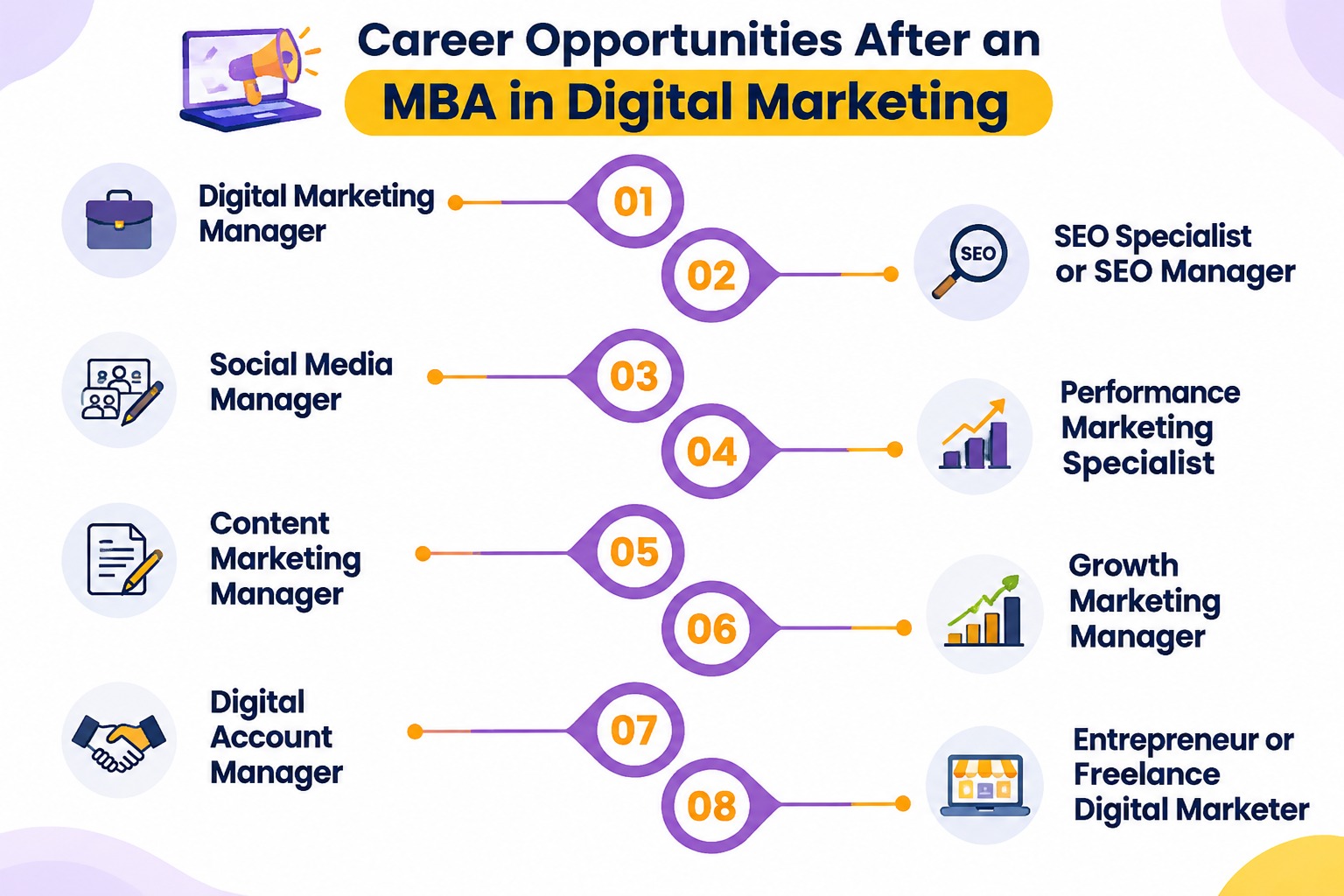
Digital marketing is not one single job function. It brings together several specialisations, which means graduates can explore different roles depending on their interests, experience and strengths.
Digital Marketing Manager
A Digital Marketing Manager plans and oversees online marketing activities. The role can involve campaign strategy, channel selection, budget planning, team coordination and performance reviews.
It requires an understanding of how different digital activities contribute to broader business goals.
SEO Specialist or SEO Manager
SEO professionals work on improving a website's visibility in organic search results. Their responsibilities may include keyword research, content recommendations, technical checks, competitor analysis and performance monitoring.
With experience, professionals can move into SEO management and broader organic growth roles.
Social Media Manager
Social Media Managers develop and manage a brand's presence across relevant social platforms. Their work can include content calendars, campaign ideas, community engagement, influencer coordination and performance reporting.
The role combines creativity with an understanding of audiences and brand communication.
Performance Marketing Specialist
Performance marketing focuses on campaigns where results can be tracked against defined objectives, such as leads, enquiries, purchases or app installations.
Professionals in this area work with paid advertising platforms, audience targeting, campaign budgets, testing and conversion data.
Content Marketing Manager
Content professionals plan communication that informs, engages or supports a target audience. They may manage blogs, website content, newsletters, video ideas, editorial calendars and content distribution.
The role calls for strong writing, planning and an understanding of brand positioning.
Growth Marketing Manager
Growth marketing brings together experimentation, customer acquisition, retention and business performance. Professionals may work across paid campaigns, website optimisation, customer journeys and analytics to identify opportunities for sustainable growth.
Digital Account Manager
Digital Account Managers often work in agencies or marketing service companies. They coordinate with clients, understand campaign requirements, communicate with internal teams and monitor project delivery.
Strong organisation and client communication skills are particularly useful in this role.
Entrepreneur or Freelance Digital Marketer
Some graduates choose to work independently or build their own digital marketing agencies. They may offer services such as SEO, social media management, content development, paid advertising or marketing strategy.
This path requires more than platform knowledge. Client management, pricing, business development and consistent service delivery are equally important.
The role you eventually pursue will depend on the areas you explore during your studies and the practical experience you build along the way.
Is an MBA in Digital Marketing Suitable for Fresh Graduates?
Yes. Fresh graduates can consider this specialisation even if they have not previously worked in advertising, marketing or communications.
The course generally begins with management fundamentals before moving into specialised subjects. This helps students understand the business context in which digital marketing decisions are made.
Students from commerce, science, arts, engineering and other academic backgrounds may find the programme relevant, provided they meet the institution's admission requirements.
For someone starting without work experience, practical assignments, internships and industry interaction become especially valuable. They offer opportunities to understand professional expectations and develop examples of work that can be discussed during interviews.
A genuine interest in communication, consumer behaviour, business growth and digital platforms can be a helpful starting point.
Can Working Professionals Benefit from This Specialisation?
Working professionals may also consider an MBA in Digital Marketing, particularly if they want to move into marketing, strengthen their management knowledge or take on broader responsibilities.
For example, a sales professional may want to understand how digital campaigns generate leads. An entrepreneur may wish to improve online customer acquisition. Someone working in traditional marketing may want to become more familiar with analytics, social platforms and digital advertising.
The suitability of a programme depends on its schedule, admission requirements and learning format. Professionals should check these details before applying, especially if they intend to continue working while studying.
What Should You Know About Eligibility and Admission?
Admission requirements vary from one college to another, so it is important to check the latest information published by the institution.
In general, students need a bachelor's degree from a recognised university to apply for an MBA programme. Some institutions accept graduates from any academic discipline, while others may specify minimum marks or additional admission requirements.
The selection process may include an entrance examination, personal interview, group discussion or an assessment conducted by the institution.
Before applying, make sure you understand:
- The minimum educational qualification.
- Whether final-year students can apply.
- The minimum percentage or CGPA required.
- Whether an entrance examination is necessary.
- Whether an interview or additional assessment forms part of selection.
- The documents required for admission.
It is also worth checking whether the MBA degree is awarded by a recognised university and understanding the role of any additional certifications offered by the institution.
How Is Digital Marketing Different from a General MBA in Marketing?
This is a common question among students who are interested in marketing but are unsure which specialisation to choose.
An MBA in Marketing provides a broader understanding of how businesses identify customers, develop products, position brands, manage sales and build market relationships. Its subjects may include consumer behaviour, market research, brand management, sales management, advertising and marketing strategy.
An MBA in Digital Marketing places greater emphasis on online channels and technology-led marketing activities. Students may study SEO, search advertising, social media, content marketing, email campaigns, website analytics and digital customer engagement.
The two areas are connected rather than completely separate. Digital marketing is part of the wider marketing function, and both programmes can lead to careers in related fields.
The better choice depends on the kind of work you want to explore. If you are interested in a broad marketing career, a general MBA in Marketing may be suitable. If online customer acquisition, digital campaigns and performance measurement appeal to you, a specialised MBA in Digital Marketing may be worth considering.
Why Practical Industry Exposure Matters
Imagine learning how to plan a paid advertising campaign but never having the opportunity to understand how a real business sets its budget. Or studying social media strategy without ever working on a content calendar for an actual brand.
There is a difference between knowing the terminology and understanding how the work happens.
Practical exposure helps students see the decisions that sit behind everyday marketing activities. A campaign may need to be changed because the target audience is not responding. A website may attract visitors but fail to generate enquiries. A brand may receive high engagement without seeing meaningful business results.
These situations teach students to look beyond surface-level numbers.
Internships, live assignments, industry projects, company interactions and practical workshops can help students develop this perspective. They also provide opportunities to ask questions, receive feedback and understand how teams work together.
When evaluating a college, find out whether practical learning is built into the programme throughout its duration or limited to a short internship at the end.
Understanding the Work-Study Approach at GEMS B School
For students who want to connect management education with workplace experience, the learning model is an important part of the decision.
GEMS B School offers an Industry Synergised MBA in Digital Marketing through a work-study approach. According to its programme information, students work with partner organisations from Monday to Friday and attend classes on weekends. The institution describes the model as approximately 70% practical learning and 30% classroom learning.
The programme is designed to combine an MBA degree with a PGP certification from GEMS B School and industry experience during the two-year course. The MBA degree is awarded by a UGC-recognised, NAAC A-grade accredited university, as stated on the programme page.
The Digital Marketing specialisation covers areas such as social media strategy, influencer marketing, Google Ads, Google Analytics and other digital marketing tools. Students can explore how marketing concepts are applied in professional settings while developing their understanding of the business side of the subject.
This approach may appeal to students who value learning through workplace involvement alongside academic study. Those considering the programme should speak with the admissions team to understand the current work-placement arrangements, eligibility conditions, university details and complete fee structure.
You can explore the programme through the GEMS B School MBA in Digital Marketing page.
Is Digital Marketing a Good Long-Term Career Choice?
Digital marketing is likely to remain an important part of business as customers continue using online channels to research, compare and purchase products and services.
That does not mean every digital marketing role will look the same in the coming years. Automation, artificial intelligence, changing search experiences, privacy expectations and new content formats are influencing the way marketing teams work.
Professionals will need to understand more than individual tools. They will need to ask better questions, evaluate information, understand customer needs and make decisions that support business objectives.
For example, automation may help a marketing team manage repetitive tasks, but people are still needed to decide what the brand should communicate, which audience matters and whether a campaign is aligned with the organisation's goals.
The strongest long-term career prospects are likely to belong to professionals who combine marketing fundamentals with analytical thinking, creativity, commercial understanding and a willingness to keep learning.
Final Thoughts
Choosing an MBA in Digital Marketing is not simply about selecting a specialisation that sounds relevant to the current job market. It is about finding a programme that helps you understand how businesses attract customers, build brands and grow through digital channels.
When comparing colleges, look carefully at the curriculum, faculty, practical assignments, internship opportunities, industry connections and placement support. Ask questions about the learning model, speak to people who have experienced the programme and verify the latest admission information before making a decision.
Digital marketing offers several career paths, but your education should prepare you to think beyond a single platform or job title. The ability to understand people, interpret data, communicate ideas and connect marketing activities with business results will remain valuable throughout your professional journey.
A well-chosen MBA programme can provide the foundation. The projects you take up, the skills you develop and the curiosity you bring to your work will help shape what comes next.
Frequently Asked Questions
1. Which colleges offer an MBA in Digital Marketing?
Several business schools and universities in India offer MBA programmes with a Digital Marketing specialisation. While comparing them, students should examine the curriculum, practical learning opportunities, faculty, industry exposure, placement support and degree-awarding university. GEMS B School is one institution offering an Industry Synergised MBA in Digital Marketing.
2. Is an MBA in Digital Marketing a good career option?
It can be a suitable choice for students interested in online marketing, brand communication, advertising, analytics and business growth. The programme combines management knowledge with digital marketing skills, allowing graduates to explore roles across agencies, startups, e-commerce businesses and established organisations.
3. What are the main subjects in an MBA in Digital Marketing?
Subjects vary by institution but commonly include marketing management, consumer behaviour, search engine optimisation, search engine marketing, social media marketing, content marketing, email marketing, web analytics and digital marketing strategy.
4. Can I pursue an MBA in Digital Marketing after graduation in a different field?
Yes. Many institutions accept graduates from different academic backgrounds, subject to their eligibility requirements. Students from commerce, science, arts, engineering and other disciplines can explore this specialisation if they are interested in marketing and digital business.
5. What jobs can I get after an MBA in Digital Marketing?
Graduates can explore roles such as Digital Marketing Manager, SEO Specialist, Social Media Manager, Performance Marketing Specialist, Content Marketing Manager, Growth Marketing Manager and Digital Account Manager. Career opportunities depend on skills, experience and employer requirements.
6. Does an MBA in Digital Marketing require technical knowledge?
Prior technical knowledge is generally not necessary for admission to many programmes. Students are introduced to digital marketing concepts and tools as part of their learning. An interest in technology, data and online platforms can make the learning process easier.
7. What is the difference between an MBA in Marketing and an MBA in Digital Marketing?
An MBA in Marketing covers broader areas such as branding, sales, consumer behaviour and market research. An MBA in Digital Marketing focuses more specifically on online channels, including SEO, social media, paid advertising, content marketing and digital analytics.
8. Is practical experience important during an MBA in Digital Marketing?
Yes. Practical experience helps students understand how marketing campaigns are planned, executed and evaluated. Internships, live projects, workshops and industry interactions can help them develop workplace skills and prepare for professional responsibilities.