
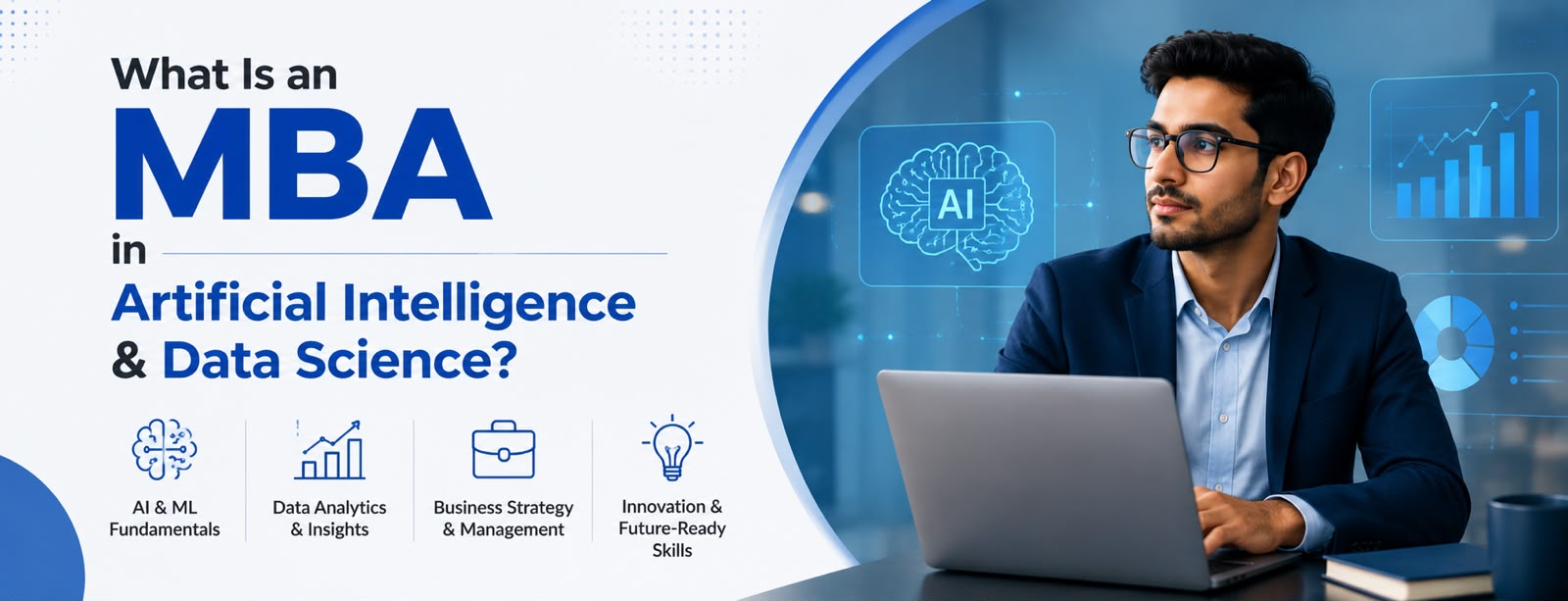
Choosing your MBA path has changed. It used to be just choosing between finance, marketing, or HR. Now, with the rapid changes in business, with technology leading the changes, Artificial Intelligence and Data Science are now embedded in the business world to help companies know their customers, improve their business, and help identify risks in the business and create solutions.
Because of this, businesses have new expectations from management graduates. They no longer want purely business graduates. They want graduates who think business, but work with technology and data business.
This is the gap the MBA in Artificial Intelligence and Data Science serves.
Maybe you found this program as you are looking for your postgraduate pathways and you are curious as to if this program is for you, how technical it is, and what will be your career opportunities after. The good news is, this MBA program is the most futuristic business program and will help you achieve your business goals, without you needing to become a coder or AI developer.
It's important to appreciate what these programs offer and why they are appealing to managers in the making.
Why Have These MBAs Gained Such Great Popularity?
Reflect on the operations of contemporary businesses.
Each of an entity's transactions, engagements, interactions, and dealings results in the accumulation of data, and businesses are inundated with data daily. The collection of data, however, is not the end of the process. Rather, data collection poses the problem of data interpretation and formulating decisions.
Managing data and deriving insights are fair game in the realm of data science. Artificial Intelligence empowers businesses to automate, detect patterns, and foresee results.
When you combine the two, the crossover becomes industry imperative.
In a business landscape that demands greater digital investment, businesses are employing more managers versed with business and future shaping technologies. This spike in demand for specialized MBAs has triggered the increased offering of these programs.
What Is The Actual Content of The Programs?
A great deal of people think that MBAs in Artificial Intelligence and Data Science, are really just a branch of engineering.
They are not.
The goal is not to become the next Computer Scientist, nor is the goal to design the next ground breaking AI. What students really learn in these programs, is how businesses can deploy AI and data in order to tackle business problems, increase productivity, and most importantly, enhance business stewardship.
These programs also contain the fundamentals of business management. However, they additionally teach students how to think about business in a novel way.
Students will likely have opportunities to study the following:
- Business Analytics
- Application of AI
- Data Visualization
- Machine Learning
- Marketing Analytics
- Financial Analytics
- Business Intelligence
- Digital Transformation
- Strategic Management
- Leadership and Organizational Behavior
Although the content may differ between schools, the goal of the programs remains the same: to enable aspiring managers to step confidently into roles within technology-based companies.
Does This Program Meet Your Expectations?
Not every student keen on AI is determined to master programming.
Numerous students seek to gain an understanding on AI in order to work in the fields of management, consulting, product, and business strategy in order to remain relevant in the fast-evolving corporate world.
If you enjoy solving problems, making decisions, and leading a team, complemented by a desire to understand how technology can optimize a business, then this program may be the right match for you.
The fusion of analytical skills and business education makes this program appealing to students with diverse academic backgrounds ranging from commerce to management, engineering, computer science, economics, and mathematics.
The program is also ideal for the technology curious from an application management vs coding standpoint.
Skills You'll Develop Beyond the Class
The value of the MBA is never confined to classroom theory and examinations.
It is the program that is most enriched in terms of value from the post-graduation skills and techniques.
From challenge and opportunity based research to data analyses for informed value-based decisions on business and industry, the MBA in AI & Data Science changes the game.
Communication, Leadership, Team Work, and Project Management and Strategic Thinking remain the focus.
Graduates develop skills to work collaboratively with data teams and tech/business professionals, positioning them to actively take part in digital transformation projects.
Such skills are essential for any industry.
What Is the Difference from a Regular MBA?
A regular MBA aims to develop a student’s management skills in areas like finance, marketing, and human resources.
An MBA in Artificial Intelligence and Data Science introduces management skills fused with technology.
Students don’t just learn conventional business skills; they're taught the effect of technology on consumer behavior, business process improvements, business predictions, and the competitive landscape.
This results in better employment opportunities in tech-centric business environments.
The programme builds on current management skills, as opposed to eliminating them.
What Are the Requirements for Getting an MBA in Artificial Intelligence and Data Science?
While each institution has its own specific eligibility criteria for an MBA in Artificial Intelligence and Data Science, there are certain common requisites.
Applicants for an MBA program are generally required to:
Hold a bachelor’s degree.
Fulfill the minimum eligibility criteria established by the institution.
Demonstrate relevant entrance exam scores (if required).
Some institutions may consider an applicant’s performance in a personal interview or other skills assessment tests.
Typically, students from BE/BTech, BA/BCom/BBA, economics, computer science, even mathematics, and other backgrounds may apply, as long as the prerequisites have been fulfilled. Since these are management programs, applicants are generally not required to have previous work experience in coding.
What Are the Possible Career Paths?
An important advantage of this specialization is the wide variety of options available. Most industries utilize data and technology to enhance their decisions and, therefore, provide ample opportunities for management graduates who are business and data literate.
An MBA in Artificial Intelligence and Data Science helps in obtaining the following positions:
- Business Analyst
- AI Product Manager
- Digital Transformation Consultant
- Operations Manager
- Data Analytics Manager
- Business Intelligence Consultant
- Project Manager
- Technology Consultant
- Marketing Analytics Manager
- Strategy Consultant
- Consultant for Digital Transformation
All the above positions deal with the use of data and AI to tackle business challenges and enhance customer experience for the better and aid in the growth of the organization.
What Are the Hiring Industries for MBAs with AI and Data Science?
The need for MBA graduates with AI and data science skills goes beyond the data science and AI-based industries.
Graduates can seek employment in:
- Information Technology
- Banking and Financial Services
- Healthcare
- Retail and E-Commerce
- Manufacturing
- Consulting
- Telecommunications
- Logistics and Supply Chain
- EdTech
- Media and Entertainment
Industries are vastly impacted by AI and data science. This can be seen with the analyzing of customer behavior and the optimization of effectiveness and efficiency in operations, as well as the design of business models and strategies.
Why Industry Exposure Is Just as Important as the Curriculum
The right curriculum provides a foundation of knowledge. However, exposure and experience provide students with the necessary tools to thrive in their careers.
More and more, employers are leaning towards the candidates that have experience and have been exposed to the real world problems of business. This can be seen through the candidates that have participated and worked on live business projects, and have completed placements and industry workshops.
These candidates will possess the knowledge of how the various theories of business will find their application in the real world. These candidates will also possess improved confidence along with the ability to communicate, work as a team, and solve problems.
The MBA is a widely sought-after degree due to the increase in knowledge gained. However, when evaluating the MBA programs, the candidates must look beyond the subjects and focus on industry collaboration, interactions with corporate employees, the support in placements, and the opportunities to gain knowledge through experience, as these areas will have a significant impact on how ready the students are to embark on their careers.
Why This Specialisation Has a Strong Future
AI and Data Science are advanced technologies no longer in their infancy. They are becoming a part of the daily functions of businesses.
Predictive analytics to track and forecast market behavior, AI and technology to enhance and optimize customer service and business processes through the use of technology and automation, are just a few examples of how businesses are operating. Technology is advanced and will continue to evolve. The need for business professionals who can bring together business strategies and data science will be imperative.
This demonstrates that the MBA of Artificial Intelligence and Data Science will help equip the candidate with the relevant tools of business and the technologies to ensure that they are ready to do business in a technology driven world.
Rather than preparing students for one specific job, the program develops skills that are valuable across any field.
Learning Beyond the Classroom
Choosing a school impacts the learning experience.
An MBA is more worthwhile when students have industry exposure through corporate mentorship, internships, workshops, and industry-related activities and assignments in addition to lectures.
GEMS B School adopts an industry-oriented learning system that offers students the opportunity to learn and interact with different professionals and experience different learning activities through a specially designed curriculum that places students in a position to learn how different businesses employ technology to solve various problems.
This framework ensures students have both the theoretical knowledge and practical skills to function effectively in the workplace upon graduation.
Conclusion
An MBA in Artificial Intelligence and Data Science is not an ordinary management specialization. It is an intersection of technology with the modern-day businesses and the reinvigorated strategic focus.
This program is appropriate for those aspiring to have a career in management with the focus area being on the optimization of business using Artificial Intelligence and data, and not a career in pure technology. It is a management-focused program that teaches the integration of new technologies, which equips students for an array of career opportunities in an age of increased competition and the value of informed business decisions.
As businesses continue to engage in the digital economy, integrated technology-enabled business-focused professionals will become increasingly sought-after. Studying a program that emphasizes learning through practical engagement, interaction with various professionals, and goal-directed activities will establish a solid professional base that ensures a rewarding career.
Frequently Asked Questions
1. What is an MBA in Artificial Intelligence and Data Science?
An MBA in Artificial Intelligence and Data Science is a postgraduate programme designed to integrate the fundamentals of business with artificial intelligence and data science. This programme prepares individuals to handle the business side of the technology domain, rather than the development of AI systems.
2. Who should pursue an MBA in Artificial Intelligence and Data Science?
People interested in business management, technology, and data-analytics-driven innovations will find this programme relevant. Individuals aspiring to take up consulting, analytics, management, or digital transformational roles will also benefit from this programme.
3. Is coding compulsory for MBA in AI and Data Science?
No. Most MBA programmes do not expect students to have advanced knowledge of coding. Students may have to learn a few analytical tools and some data literacy, but the main emphasis will be on the application of technology to the business domain rather than the development of applications.
4. What are the career choices after this MBA?
Some of the career roles that interested individuals may pursue are Business Analyst, AI Product Manager, Technology Consultant, Data Analytics Manager, Business Intelligence Consultant, Strategy Consultant, and Digital Transformation Manager, among several others.
5. Can students from a non-engineering background pursue this MBA?
Yes. Students from any background, including commerce, business administration, economics, and humanities, may pursue this MBA, provided that the students meet the eligibility requirements mentioned by the institution.
6. Which industries hire MBAs with AI and Data Science?
Industries such as IT, banking, healthcare, retail, consulting, manufacturing, logistics, e-commerce, telecommunication, and education hire MBAs with AI and Data Science.
7. How does an MBA in Artificial Intelligence and Data Science differ from an MBA?
A standard MBA is based on the study of business management. This specialization, however, integrates management training and education in Artificial Intelligence, data analytics, and business intelligence to train students to operate in technologically oriented business environments.
8. What are the key considerations when selecting an MBA in Artificial Intelligence and Data Science?
When selecting a program, students should assess the curriculum, faculty experience, partnership with the industry, internships, job placement assistance, and the inclusion of real-world work and experiential learning. These features are important for students’ future careers and their development in the profession.