Choosing a post-graduate program is especially challenging considering how rapidly artificial intelligence is developing. A quick search reveals countless options. It can be difficult to know which path to take. Two programs that frequently cause confusion for applicants are the MBA in AI and the MSc in AI.
At face value, the programs are similar. They both include artificial intelligence with the possibility of pursuing a related career in the technology field. Additionally, they both cater to individuals interested in working in one of the world’s fastest growing industries.
However, these are the only similarities.
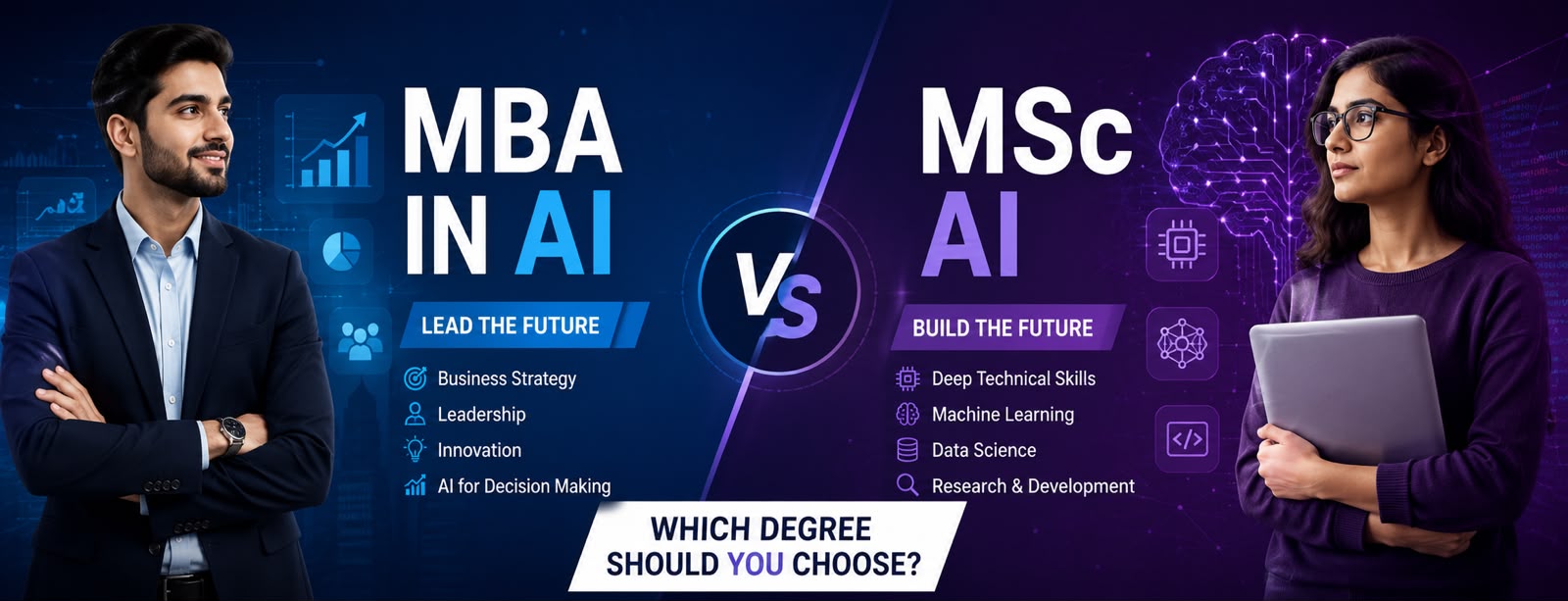
In fact, there is a stark contrast between the two programs. The MBA in AI program provides an individual with the ability to understand how businesses can leverage artificial intelligence to make decisions and ultimately grow the business. The MSc in AI program builds the technical skills necessary to design and develop artificial intelligence systems.
Having an understanding of the stark difference before applying to these programs may aid in preventing a poor decision that may lead to a conflict of interest with one’s end goals.
Why is There Confusion between the Two Degrees?
Artificial intelligence is being integrated into all areas of business. AI is being used to automate repetitive tasks, provide personalized experiences to customers, predict shifts in the marketplace, optimize the supply chain, and even help with hiring decisions. It is no surprise that many are including artificial intelligence into business-related conversations.
In response, universities have created additional management and AI integration programs. They have also added traditional AI-focused technical programs.
For students looking for a postgraduate program, programs can seem to have the same names. What is different are the experiences students have, the environments, and the ultimate outcomes.
Instead of program "better" comparisons, it is more helpful to determine which option aligns with your desired profession.
Not Building Technology? Your Program May be Different
Consider the kind of challenges you enjoy.
Is solving programming problems rewarding for you? Do you get curious about how different recommendation systems operate? Do you enjoy and find the value in the process of constructing applications, or do you model and play with different machine learning paradigms?
If you enjoy any of the above, an MSc in AI could be a good fit for you. These programs go into the details of the different programming and algorithmic frameworks, as well as neural networks and machine learning paradigms. The majority of the courses are dedicated to building the skills to develop different intelligent systems.
The most common outcome for those graduates is to work in roles that develop, refine, and implement AI systems.
If You Prefer Solving Business Challenges
Now think about a different scenario.
Instead of coding, you are writing an analysis and you are in a meeting with a cross functional team. You are finding opportunities to use AI to optimize a different process, digitally enhance customer touch points, or reverse engineer cost savings. You are developing a strategy and decision, as opposed to coding.
This is the type of environment an MBA (AI) would be preparing you for.
The program incorporates management training with new technologies. This allows students to see how AI integrates with marketing, finance, operations, strategy, and business transformation. This program is more focused on how to leverage Artificial Intelligence to drive business results, rather than concerning itself with the technicalities of coding.
For students passionate about leadership, creativity, and cross-sector collaboration, this program is more valuable to them.
The Learning Environment is Unusually Variable
Even though both programs contain "Artificial Intelligence" in their title, the learning environment is disparate.
Lectures for an MSc. tend to be more technical in nature. Students tend to engage in the completion of coding tasks, the construction of mathematical frameworks, the writing of research papers, the development of software, and the execution of technical projects. Success in these environments tends to require advanced analytical and technical problem solving skills.
In comparison, the learning environment of an MBA. tends to be more broad in nature.
Lectures tend to focus on discussions around business strategies, market and consumer research, AI, and other organizational challenges. Students tend to engage in the completion of case studies, group projects, and work-related tasks that are industry relevant.
Both methods have merit, however they prepare students for different careers.
Your aspirations should be the primary focus of your decision.
Instead of the more traditional beginning to this process of listing job titles and salaries, it is more relevant to now ask yourself this:
In what areas would you prefer to be engaged in work 5 years after completing this program?
If your passion is the development of AI, research, and undertaking advanced machine learning, an MSc. is the more relevant option.
An MBA can give you a better base if you see yourself leading digital transformation initiatives, launching AI-enabled offerings, managing cross-functional teams, or pushing the boundaries of technological adoption for organizations.
Your daily tasks post-graduation will reflect the path you choose.
The Skills You'll Build Along the Path
One of the key differentiators between the two tracks is the skills they cultivate.
The focus of students in an MSc in Artificial Intelligence program is the development of technical skills. Each day they are immersed in the study of programming, data modeling, machine learning, algorithm design and optimization, and computational thinking.
MBA students are on a different journey. They gain the ability to analyze and interpret quantitative business data, engage in and manage business projects, develop written and oral communication skills, and learn to lead teams, all the while gaining an understanding of the role technology plays in the evolution of business.
Organizations value both of these skill sets.
The most successful AI initiatives recognize the value of independent technical and business skills.
Where Can Each Degree Take You?
Both degrees will get you a career in Artificial Intelligence, the difference is what type of career. The good news is that the MSc in Artificial Intelligence will prepare you for the most technical roles. These roles will focus on tasks like coding to develop AI, analyzing large data sets to develop and enhance machine learning systems, and developing AI models. Common careers in this area include AI Engineer, Machine Learning Engineer, Data Scientist, Robotics Engineer, and Research Associate.
An MBA in Artificial Intelligence is useful for integrating tech into business and strategic functions. Graduates typically become Product Managers, Business Analysts, Digital Transformation Consultants, AI Strategy Managers, Technology Consultants, or Operations Managers. They do not need to design AI solutions. Instead, they support companies in understanding where AI is of the utmost importance and in delivering projects with clear business objectives, in an effort to generate value.
As AI features in core business functions, it becomes more important to have skills that combine business and technology at the operational level.
Which Sectors Hire These Graduates?
Technology is no longer the sole focus of companies investing in AI; it has become multi-sectoral. As a result, there are opportunities for graduates of both disciplines.
AI is enhancing diagnostics and patient care in Healthcare. In Banking, AI is now used for fraud detection and risk assessment. The Retail sector uses AI to understand consumer behavior for personalized shopping. Production in Manufacturing is being optimized through AI, while Logistics uses AI to analyze data patterns for more efficient Supply Chain Management.
For graduates with a technical background, these sectors present opportunities for the design and improvement of AI systems. Graduates with MBA qualifications can manage AI initiatives, innovation projects, and digital transformations.
The same sectors can employ both graduates, but their roles can be very different.
Which Qualification Has Higher Earning Potential?
This is an interesting but complex question for prospective graduates.
Compensation is a complex issue involving a great number of variables including location, education, experience, and the individual’s unique context. For example, a talented AI Engineer will have the potential to earn more than someone with a great deal of experience as an AI Product Manager or as a Strategy Consultant.
Earning potential is not split up by degree, so if you are choosing which degree to pursue, the more relevant consideration is which of the three potential careers matches your interests. Genuine long-term career success is more likely to happen when an individual is doing what they love and continues to develop their professional skills.
Ultimately, select your degree based on what you love because when you love what you do and have advanced skills, your degree will become less important over time.
Questions to Ask Yourself Before Making a Decision
Choosing a post-graduate degree is much simpler when you are self-aware, rather than assuming what the employers want.
Consider the following:
- Do I prefer tech or business problem solving?
- Am I okay with math and coding?
- Do I want to build the AI or manage the projects using AI?
- Which career do I see myself enjoying in the next 5-10 years?
- Does this program develop these skills with practical work and industry engagement?
You will be able to answer these questions with far more certainty than choosing based on rankings or general course descriptions.
Why Practical Learning Matters More Than Ever
Making a career in AI is very difficult at the moment as the field is developing incredibly quickly. So practical knowledge is as important as theoretical knowledge because with each passing year new tools, frameworks and applications are introduced.
Graduates today are expected to have completed real projects in collaboration with professionals as well as have some understanding of the role of AI in the workplace. Internships, live case studies, participatory workshops, and meetings with company representatives aid the development of students’ skills and play an important role in the development of their sense of professionalism.
While examining different postgraduate programmes, try to look beyond the course outline. You may find that the quality of internships, industry exposure, and placement assistance is critical to your career readiness.
Connecting Business and Industry Education
Management training is highly focused on industry training, especially in the case of technology-based fields. Training institutions that supplement classroom instruction with business training ensure that students are able to complement their understanding of the theories with knowledge of how the technologies are applied by business.
GEMS B School adheres to this model by including industry training, live projects, internships, and other forms of practical learning in addition to classroom instruction. This approach helps students develop both the business skills and the practical skills that are needed to be competitive in the job market.
Students are prepared to deal with the business world rather than learning ideas in abstraction.
Conclusion
While both an MBA in Artificial Intelligence and an MSc in Artificial Intelligence have the potential to open career opportunities, they are fundamentally different.
For those with an interest in programming, research, and the construction of complex systems, the technical degree provides the depth of training for a career in Artificial Intelligence.
For those more interested in the business side, the degree in business administration provides the tools to design and construct solutions for business challenges using Artificial Intelligence.
Your career is shaped by the kind of professional you choose to be. Popularity and salary comparisons will not determine the right choice.
While considering your options, examine the details provided by the institutes about their curricula, pedagogies, industry exposure, and placements. Evaluate the opportunities that would best support your career trajectory. A program will always yield a better return on investment when it considers your strengths and passions.
Frequently Asked Questions (FAQs)
1. Which is better for my career prospects: an MBA in AI or an MSc in Artificial Intelligence?
There is no one “better” programme. An MBA in AI is for the students interested in business, strategy, and the leadership and management of AI-enabled enterprises. An MSc in Artificial Intelligence is for the students who seek to build AI technologies, design and construct algorithms, and occupy professional positions in IT.
2. Is it possible to get an MBA in AI without being technical?
Definitely. A number of MBA in AI programmes accept students of commerce, management, and or economics, and other non-technical areas. Even though developing some levels of basic analytical skills is an asset, the emphasis will be on the understanding of AI and its role in growing business enterprises, and not on developing sophisticated AI models.
3. Is it important to know how to code to pursue an MBA in Artificial Intelligence?
Coding will not be the main focus of an MBA in AI. While some programmes may create space in their syllabus for a few basic ideas related to data and AI, the bulk of the programmes are likely to focus on the management, strategy, and business technologies and their applications.
4. What are the potential future roles after completing an MBA in AI?
AI-enabled enterprises may recruit graduates to the positions of AI Product Managers, Business Analysts, Digital Transformation Consultants, Technology Consultants, or Strategy, Innovation, Operations, and Business Development Managers.
5. Who is an MSc in Artificial Intelligence programme suited for?
An MSc in Artificial Intelligence programme is appropriate for students who have interests in coding, math, and AI and enjoy the challenge of solving technical issues. This programme will prepare students to enter the domains of AI, data, robotics, and research.
6. Do companies care about dual MBA and AI degrees?
Yes. Companies need a blend of IT and business professionals as they continue to adopt AI. The knowledge from dual MBA and AI degrees helps with business leadership for digital transformation, AI, and innovation across all sectors.
7. What do I need to think about as I decide between an MBA with AI or MSc with AI?
Consider your career ambitions, your motivations and how you want to work. If your aspirations are to manage teams, do higher level work and more strategic decisions, then go with the MBA with AI. If you want to work with AI and enjoy computer programming, then go with the MSc with AI.
8. What criteria do I need to use to evaluate an AI program at a higher learning institution?
Evaluate other elements and not just rankings for a program. Look at and evaluate the courses, the staff, connections to the business world, internships, support for job placement, live projects and other experiential learning opportunities. AI programs with connections to the industry have better chances of helping you learn the skills you need to have to be a competitive candidate in the work market.